

 All right, it's time to ask for clarification directly from the owner of the agency, my agency, Himalayan Mentor.
More than clarification, an entire power plant. Between me and Mr Kesh, as the man signs himself, a dense correspondence is triggered.
Entire months of writing to each other.
Detailed questions, mine.
Equally detailed answers, his.
Every day, a different question.
Every day, punctual, his answer.
One hundred and forty-four emails in total, not counting the attachments. A book.
From April to October, right up until the departure.
And so I finally make my choice: Langtang Gosaikunda.
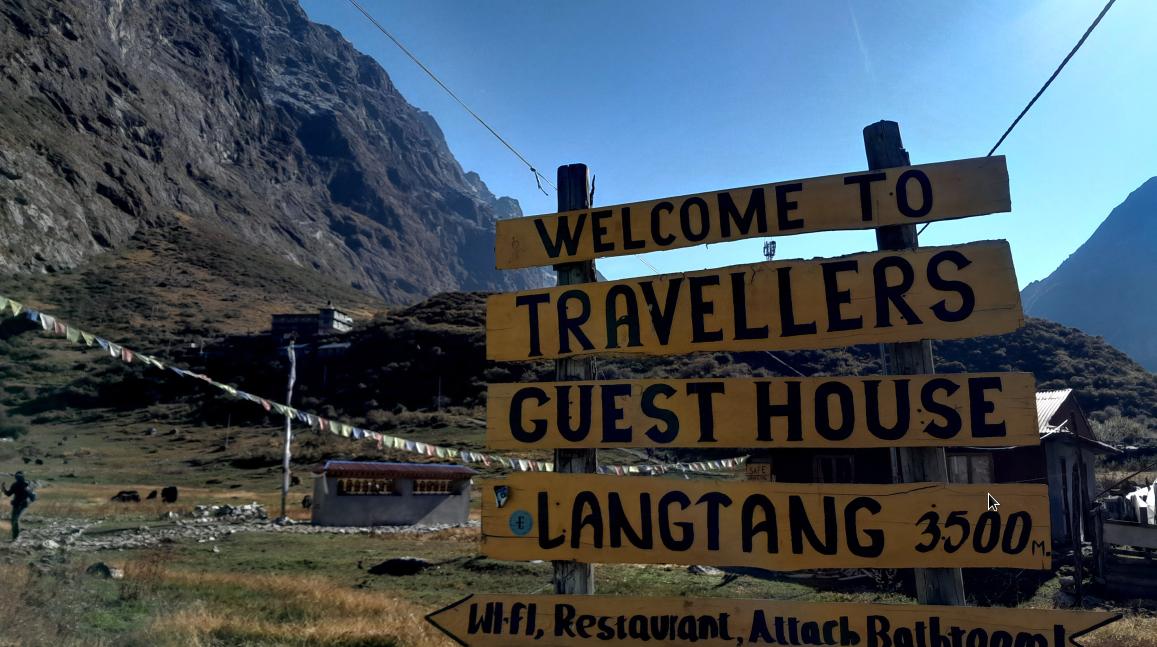
The Langtang is a rushing river that gives its name to the entire valley. The valley winds north of Kathmandu, skirts the border with Tibet and covers a vast area that includes the subtropical forest at the lowest altitudes up to the glaciers of Langtang Lirung, the highest peak in the valley, seven thousand two hundred meters above sea level. The ascent of the river allows you to come into contact with the most varied registers of biodiversity, until the vegetation, with a very thick undergrowth and tall conifers, fades onto the living rock, at an altitude of three thousand five hundred. It is at that altitude that the peaks whitened by perennial snow begin to guard the valley. From Langtang Village the mountain ranges open like a curtain, as far as the eye can see. The names of the villages all sound in English, in reality they are declensions depending on the guests, the signs at the entrance to each village bear the proper Nepalese name under the English one of the facade.
When I make my choice, I start to gather information about what awaits me: if before I consulted hundreds of agency websites to glean as much information as possible about the itinerary and prices, now I return to those websites with a more refreshed spirit but with the greed of the burning heat of the desert, driven by the need to absorb everything, everything about Langtang Valley and its villages, the peaks that tower over it, the nature of the routes, the differences in altitude, the slopes, the views, the details, the suspension bridges, the local people. From agency websites I move on to videos on YouTube. I create my own playlist with all the videos - ALL - on the platform relating to Langtang Valley. In reality that playlist, even though I had intercepted all the videos about Langtang Valley, cannot be exhaustive: every day I find new videos from users who have already been there and who publish their vlogs. This makes my research activity even more frenetic and my curiosity even more avid. And my dreams are more ethereal and volatile and voracious. My imagination soars higher. I fly high like an eagle, and like an eagle that spots its prey hundreds of meters below and dives headlong, I turn my gaze and catapult myself onto the unseen detail, onto the glimpse, onto the peaks that those videos I have already seen dozens of times have overlooked.
When my thirst is satiated with panoramas and views and snow-capped peaks, I focus on the practical aspects.
It is quite a difficult thing to sort through many of those videos. One, two users at most have managed to put together documentaries of great charm, with a sense of history and a lot of talent but they are professionals, people equipped with tripods and high-quality technical resources and experience.
For the rest, poor material, amateur like school trips, with many faces, loud laughter, many selfies, a lot of joy and very little else, in which the compulsive spring of chattering covers everything else.
In the vast majority of cases it is material shot with action cameras, which means wide-angle lenses with the so-called fish-eye effect that tends to distort the image.
Nevertheless, that material like that is useful to me.
Sometimes it happens that the user frames the path, then I watch the same video dozens of times, dwelling on the details, back and forth, back and forth.
Or on the food. What do they eat in Nepalese villages at four thousand meters above sea level? The answer is also in those ramshackle videos, and so down to watch them dozens of times: dalbhat, fried rice, fried vegetables, cholapati, omelette and many varieties of tea.