

 October 9, 2024, day 3
The next day we start walking around 07:30. The sky is clear, the sun is still just a gleam. The surrounding peaks envelop us with their shadows. Padàm explains to me that it is always like this there: in the morning the sky is clear, in the afternoon thick clouds cover the peaks. From an altitude of three thousand meters and above, it snows at night.
In the first stretch of a few kilometers our path skirts the river along its course. It is a wide and muddy track, used by the construction site vehicles. The sun rises right from the bottom of the valley, the river is tinged with blue.
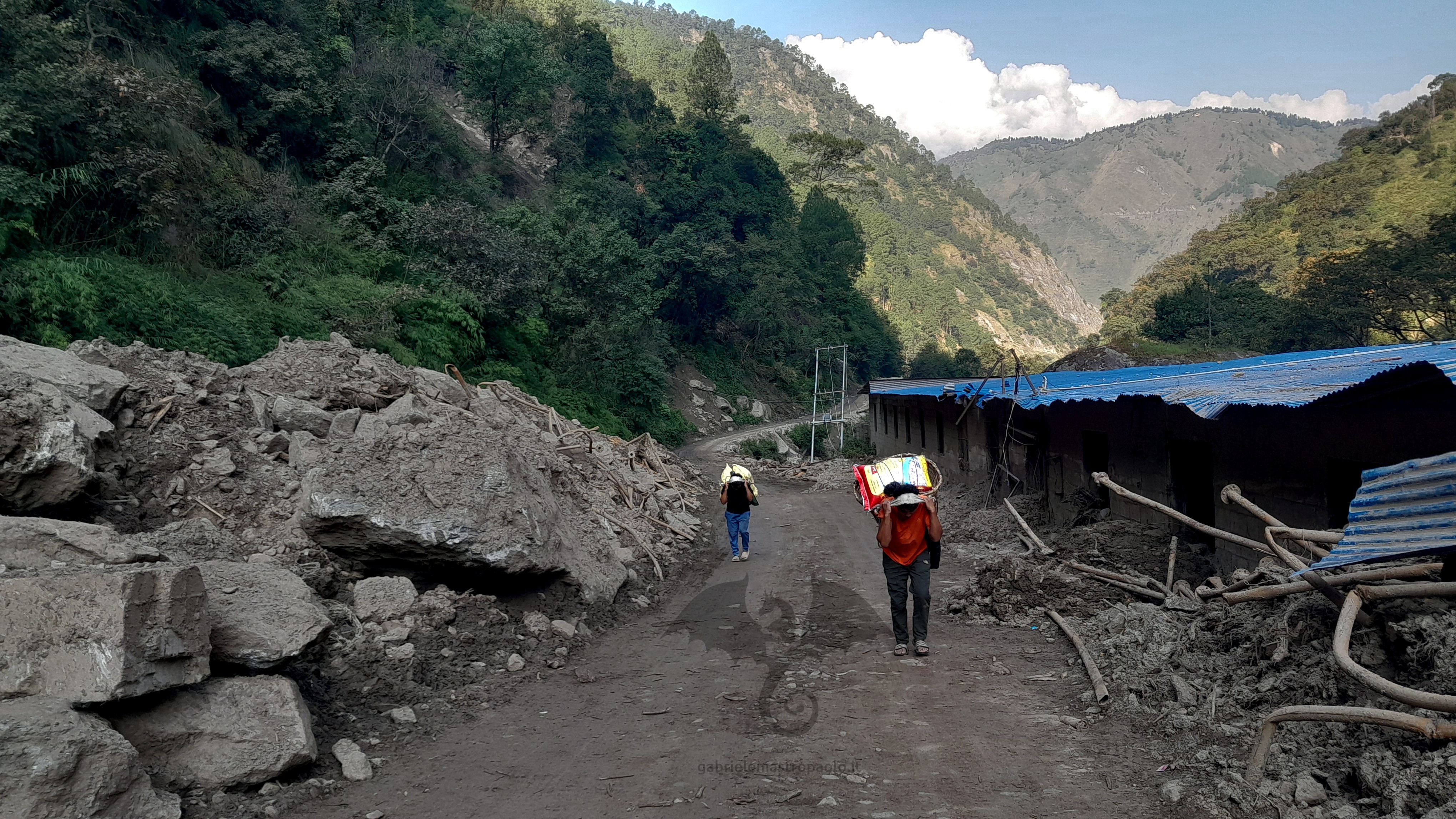
Waterfalls burst from the side of the mountain to fall on our path. Two figures rest at the edge of the river. They are two Sherpas, two boys in their twenties. They are fiddling with their cell phones. A Bluetooth speaker plays techno music with a Nepalese twist. Next to the Sherpas, two bundles. They must weigh at least fifty kilos each. Refreshed, the boys load themselves with aftershocks. The weight bends them so much that the only thing they can see is the ground and their shoes. Shoes. Not like mine, technical boots suitable for long and rugged walks. The two Sherpas are wearing plastic beach slippers. They will wear them for the entire duration of the walk, a long walk made of rocks, mud, almost vertical climbs, with differences in altitude of up to a thousand meters. Here in the Himnalaya, goods circulate like this, with Sherpas or donkeys. Padàm explains to me that he has done that job for five years. A Sherpa is paid by weight, the more he carries, the more he earns. He can carry up to seventy kilos.
- And how much does he earn? - I ask.
- Two hundred and fifty, three hundred Nepalese rupees per trip, - Padàm tells me, and laughs. He laughs a bitter laugh. At the current exchange rate, one hundred and forty-two Nepalese rupees are worth one euro. The Sherpas carry up to seventy kilos on their shoulders for tens of kilometers a day and a thousand meters of altitude difference with a net earnings of two euros. Two euros.
We reach the nascent structure of the dam, a concrete pour on the riverbed. A little further on, the mud track gives way to the actual path. Finally, our shoes are on native soil. Finally, we enter the forest. Finally, we climb.
The roar of the river escorts us. The smells of the vegetation inebriate our sense of smell and imagination. The images prompted by those smells are not the ones my eyes see, they are not the ones I have seen hundreds of times in videos on YouTube. They are other images, of unknown origin, whose reverberations are equally unknown. They are something new. That sense of the unknown, that not knowing what and that not knowing how excite me. It is the absence of me that pulsates. Those olfactory images evoke intangible concepts, concepts that were there before me and in their long and distant course now find an outlet in me, like the powerful currents of the Langtang that flow a few meters away.
Twelve kilometers of trail and nine hundred meters of altitude difference await us. A steep climb but nothing so new.
The destination is Lama Hotel.
We reach Bamboo. It is a village with a few buildings but compared to the villages with single houses that I will find along the way, this is already a small town. It is perched on a rocky ridge that immediately overlooks not the river but the force of the river. The Langtang is its force. Except for a few, short stretches, the Langtang is not a swimmable river. The current would break the bones of a rhinoceros. Lloyd Wright's Fallingwater, amateur stuff.
We take a break. We order lunch, my first lunch in the valley. It will all be a mix of first times, first loves.
The village is full of hikers, hikers of all ages. Technical T-shirts soaked in sweat, tanned arms, bare feet, phosphorescent colors of backpacks resting on dry stone walls, soft words in a babel-like English. And of course the smells of fried vegetables and boiled rice.
Padàm takes my order. After a few minutes he hands me my dalbhat with his usual servant bows. I am annoyed but I have already pointed it out to him. The word sir is his favorite interjection. What do you want-sir, good morning-sir, good night-sir, look here-sir, look there-sir, we will go a very steep stretch-sir, we will go a flat stretch-sir. Each interjection is accompanied by bows. It is stronger than him. For him it is a habit.
- Drinks-sir? -
- Do they have beer, - I tell him.
- Sure-sir, do you prefer Tuborg or local beer-sir? -
- Let's try the local. - I answer.
The local beer will be good. And the dalbhat too. Ten minutes of post-lunch relaxation.
- May we go? - I ask him.
- Sure-sir! -
Backpacks on, we continue walking.
The path gets steeper. The roar of the Langtang fills all the gaps. The path is a coming and going of people, distracted and distracting people, mostly chatty and noisy people, inconceivable for a place like that. They take selfies, they shout, they show off to the women, the women show off to the boys, they pose. Bluetooth speakers blare techno music. I would slap everyone. But these are adventurers without a future: they will stop at the lowest altitudes, they will rest on the edge of the trail with their running sneakers and their tongues hanging out and the energy bars that they will not know what to do with, except throw the papers on the ground. The trails are dirtier than I imagined. My guide confirms that they are the locals. The most daring are the most motivated, the most sensitive to the cause. Group hikers or solitary hikers, we are the most silent, the most collected on our shoes, on our thoughts, swollen with our amazement. Our amazement gallops against the current on the bed of the Langtang, overcomes its impetus and heads straight for Kijangjin Gompa, the last village in the valley.
In front of me are two boys, probably Indians, with a rather fluent way of speaking. Immediately in front of them is a hero, a monument to diligence, a champion of temperance: a solitary hiker. The two chatter and breathe down his neck. They probably don't realize it. I wonder how he doesn't realize it. I respect him. He hits the ground with his sticks, his head down to calibrate his feet and their movements. The path is full of traps for ankles and malleoli, one false step and it's over. Sometimes the sticks hit harder, perhaps to better affect the ground. Or perhaps not. I begin to suppose that that relentless hitting is actually the echo of a discomfort. It is the solitary hiker himself who resolves my doubt: he stops, turns around, invites the two chatterers to continue on. He doesn't utter another word, but it's easy to read between the lines a heartfelt "fuck you." The path turns downwards. On the left, the roofs of some buildings: Lama Hotel.