

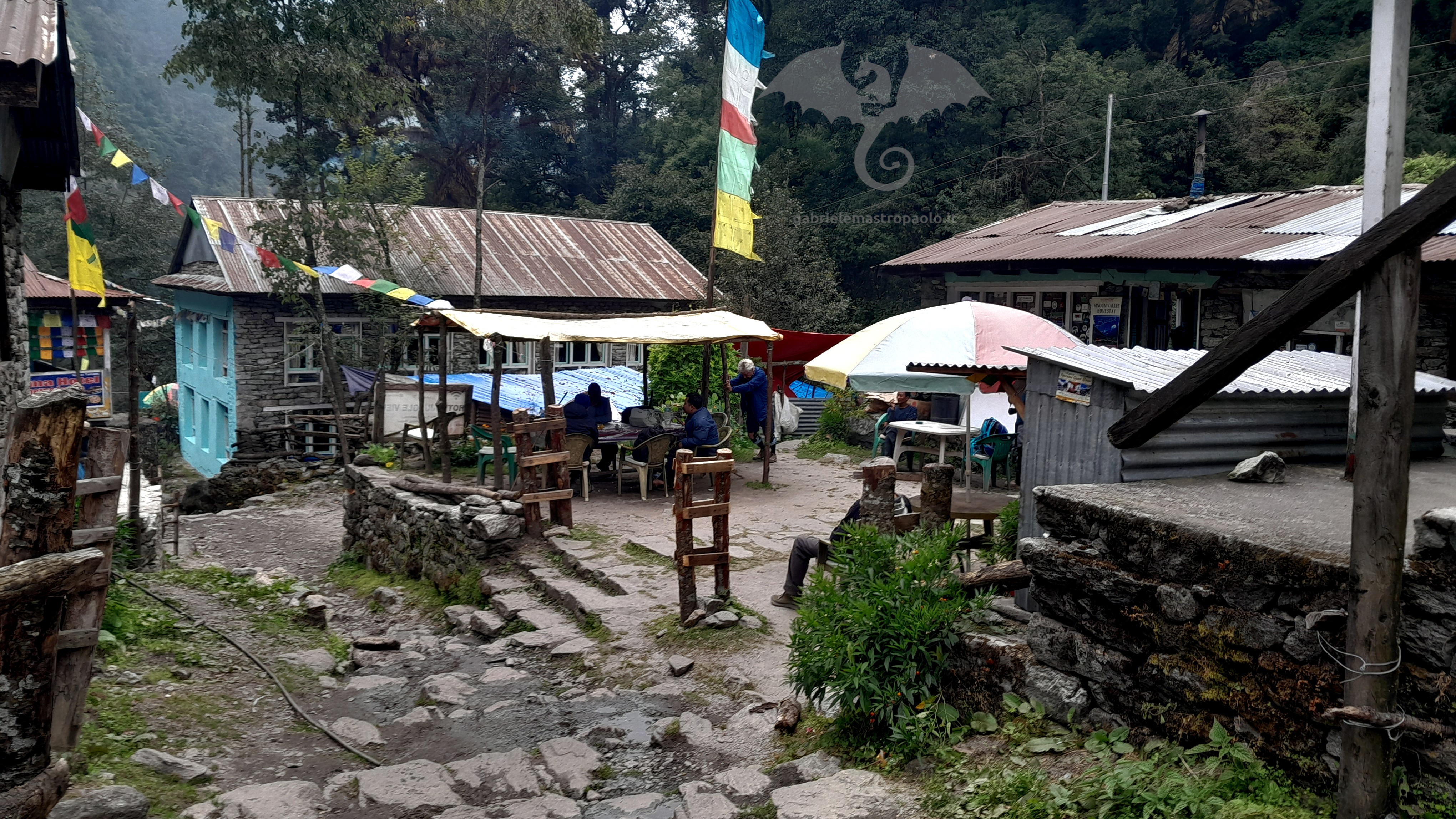
 Despite the name, it is not a hotel but a village, a collection of buildings used as guesthouses each with its own repertoire of tired hikers and hikers ready to go again, grimaces of pain and happy faces, backpacks on shoulders and backpacks on the dry stone walls.
- There is a problem-sir. -
Padàm looks at me with a contrite face in a grimace.
- Tell me, - I say to him.
- We don't have rooms. -
- What do you mean? - I say to him.
- The guy where I booked told me on the phone that there are groups and the rooms are for groups. Business-sir. -
- And the reservation, then? - I say to him, - If you have booked he must give you the rooms. -
- Business-sir, - he repeats.
A guy approaches him. They start speaking in Nepali. The guy looks at me. In turn I look at him. I approach him and say:
- Please, give us a room. -
He watches me in silence, then turns to Padàm in Nepali, gesturing with his face toward the rooms. Padàm says to me:
- We have the rooms-sir. -
The guy says to me:
- Hello friend. Padàm's friends are my friends.- And he hands me a key with a padlock.
- Number 9 is your room, - he says to me. - Welcome, sir. -
I offer him a hand with a heartfelt thank you. I head with Padàm toward the room. After opening the door, I put my backpack on the floor. Padàm does the same with my second backpack, which he is responsible for.
- That man is kind. He got us out of a real pickle. -
Padàm watches me.
- Where is the guesthouse where you initially booked and that gave us the boot? I'm curious to see the face of the asshole who refused us the rooms. -
- It's this-sir. I had booked here. -
- Ah, - I say.
Padàm doesn't give me the chance to say anything else, he walks off towards the dining room without saying one single word.
Lama Hotel is a village nestled between rock walls whose peaks cannot be seen. It is close to the river. Here, as in Syabrubesi, the roar of the Langtang is one with the biorhythm of the people who live in the village.
I get familiar with the room. From the backpacks I take out the necessary for changes and the minimum for toiletries. Before leaving, I had obtained a series of zip-lock bags creating compartments inside the backpacks dedicated to t-shirts, socks, etc. Organization of contents. When you go on a two-week trip and every day you carry all your stuff with you, you have to organize your stuff well, if you don't, the risk is spending half your time arranging and rearranging the contents of the backpacks. Before entering the room I noticed a very rickety wooden cabin with two equally rickety entrances located just beyond the rooms. On one it says toilet in English, on the other hot shower. Inside, it's pitch black. As I unpack my stuff, I've already decided that the shower can wait this time. From my backpack I take out a pack of wet wipes.
The dining room is also a dormitory. There are signs of the night gone by, unmade duvets, pillows, blankets on the benches. I like that sense of promiscuity. I like that sense of precariousness. It is part of the journey, it is part of that sharing of spaces that cannot be peremptory, cannot be regimented. The feeling of being a guest, of finding yourself passing through a temporary whole. I am looking for a temporary center of gravity, to paraphrase Battiato. Permanence does not belong to me. The idea of a center does not belong to me. It does not belong to the world, it does not belong to the universe. A common mistake is to consider the big bang as the center from which the universe originated. The universe has no center, or rather it does not have a single center. The universe expands constantly from a myriad of centers. The Hubble constant measures this movement of expansion of the universe. The Hubble constant actually tells us how variable the universe is. Any point in the universe is its center. We are not things, we are phenomena of things. We are not made to stand still, we are made to move. We do not see things, but things that mean other things. Another paraphrase, the good Italo Calvino.
The dining room of my guesthouse excites me. I had seen those spaces, that wood stove, those glimpses of the kitchen hundreds of times on YouTube, and now I was there. The Sherpas sit around the stove. They wear wool hats and down jackets. Flip-flops on their feet, they stretch them toward the flame of the stove. They tell stories, they joke, they laugh, the few Nepalese women present make bets.
I sit on the bench, I take a menu. The trusty Padàm asks what I order. Veg choumin, Nepalese spaghetti with vegetables. Ten minutes later, Padàm returns with a plate full of veg choumin. The look and smell are inviting. My stomach rejoices. The taste is excellent. I ask for seconds.
A man and a woman to my right are watching me.
- So hungry, - I tell them.
They laugh. The man has his menu in his hand, he examines it carefully, undecided.
- You gave me an idea, - he says to me in an English with a strong French accent. - And then, what better review, - he says to me.
- I understand, I was your guinea pig, - I say.
They laugh again.
With the two Frenchmen the chatter starts. It turns out that I'm Sicilian,
- Oh, I've been to Sicily, beautiful! - he says.
- Where, in particular? - I ask him.
- Oh, a nice long tour, Aeolian Islands, Trapani, the volcano. -
- Etna. -
- Yes, right, Etna. Wonderful. I want to go back to Sicily. And you, do you speak French? Have you ever been to France? - - No, maybe, - I answer.
- Eeeeh, but then...! - the man and the woman say in chorus. We laugh.
- But I want to go to Corsica, - I say, - I want to do the Grand Randonnè 20. -
- It's the first time I've heard it said in full. Usually I only hear GR20. -
- I have a thing for names, - I say. In the meantime, a tall, thin man offers them plates. Their sherpa. Their servant in pectore.
The woman speaks.
- And where are you going, up or down? -
- I'm going up, - I say. - Tomorrow, direction Langtang Village. And you? -
- We're going down, for us it's almost over. -
- And what are you taking back to France from this trip? - I ask them. - What's left inside you? -
- Without a doubt Tserko Ri, - the woman replies. - You will go to Tserko Ri? -
- I will go to Tserko Ri and Kjiangjin Ri, - I reply.
- Both? - they blurt out.
- Yes, - I say - I will arrive at Kijangjin Gompa for lunch, I will have plenty of time to go up and Kjianjin Ri, the next day I will go up to Tserko Ri.-
- That is crazy - she says. - Usually you do one or the other. Also consider that to go up to Tserko Ri you will have to leave at night, we left at 4. You will not have time to rest. -
- I do not know if this will be a unique opportunity - I say. - It certainly is at the moment. I do not want to waste it. Who knows if and when I will return. It is worth trying Kjiangjin Ri and Tserko Ri. If I succeed, good. If not, never mind. I do not like regrets. -
The man and woman begin to eat their dinner. In the meantime, I have finished mine. The room has started dancing to the techno music. The guy, the boss, comes out of the kitchen in obvious alcoholic euphoria. He stamps his feet on the wooden floorboards. The music follows. He sings. I mean, he sings: he screams. I detect hints of hysteria but maybe I'm wrong. The Sherpas around the wood stove clap their hands in time.
But yes, I am wrong.
The night passes punctuated by visits from the sciatic nerve. Excruciating pains. Then, as usual, I collapse exhausted.
The faint light of dawn emerges from the thin glass of the windows of my room. With barely six hours of equally scarce sleep under my belt, I decide that is enough. I dedicate myself to my toilette. I put on my shoes. I go out. It is barely six o'clock, it is already a swarm of hikers, of sneezes, of coughs. I have an urgent need but I'll pass on using the toilet this time, I'll shit in the branches.
Breakfast with Nepalese bread, honey, omelette and ginger tea.
At 7 we're on our way.