

 October 22, 2024, day 6
The reason for the nightly rising is twofold: the length of the route and the difference in altitude are almost double those for Kjangjin Ri, eighteen kilometers there and back for eleven hundred meters. And then there is always the constant overcast sky. Being higher, Tserko Ri is more exposed.
We set off in the dark. I have a headlamp but I don't need it. The sky is clear, dotted with a myriad of stars, never seen so many stars like this; the moonlight sufficiently illuminates the ground, the stones, the stream beyond Kjangjin Gompa. And the still dark silhouettes of the mountains with the sharp contrast of the white of the peaks. The slopes of Tserko Ri are streaked with a row of moving lights, they are the hikers who preceded us, less in love with the moonlight than we are. We cross a stream. In Sicily that watercourse would have been classified as a river. We begin to climb. Groups of hikers are already lining the first bends. They are gasping. Deep gulps of air to make up for the oxygen. At the top of Tserko Ri it is at fifty-five percent. As for me, the fatigue is still far away, the training at Kjangjin Ri is useful to me but I proceed extremely slowly, we have all the time, and above all I intend to enjoy it all, moment by moment, meter by meter, breath by breath. During the climb the number of the fearless will gradually fade.
With the other hikers we encourage each other, we tell each other - ourselves more than others - that it's not that far, we advise each other to go slowly, to rest often, to drink lots of water.
A voice behind me asks permission. I let him pass. He's a tall, bearded man, he says something to two others, he's Slavic. He walks quickly, planting his poles on the rocks and he's wearing only a t-shirt with a down jacket. It's about five below zero. Reckless, I guess. I lose him, he's going fast. After an hour I meet him again but he comes down. He looks at me.
- Too cold, I can't do it, - he says as if to apologize - all this is enough for me - he brandishes a pole and points to the view.
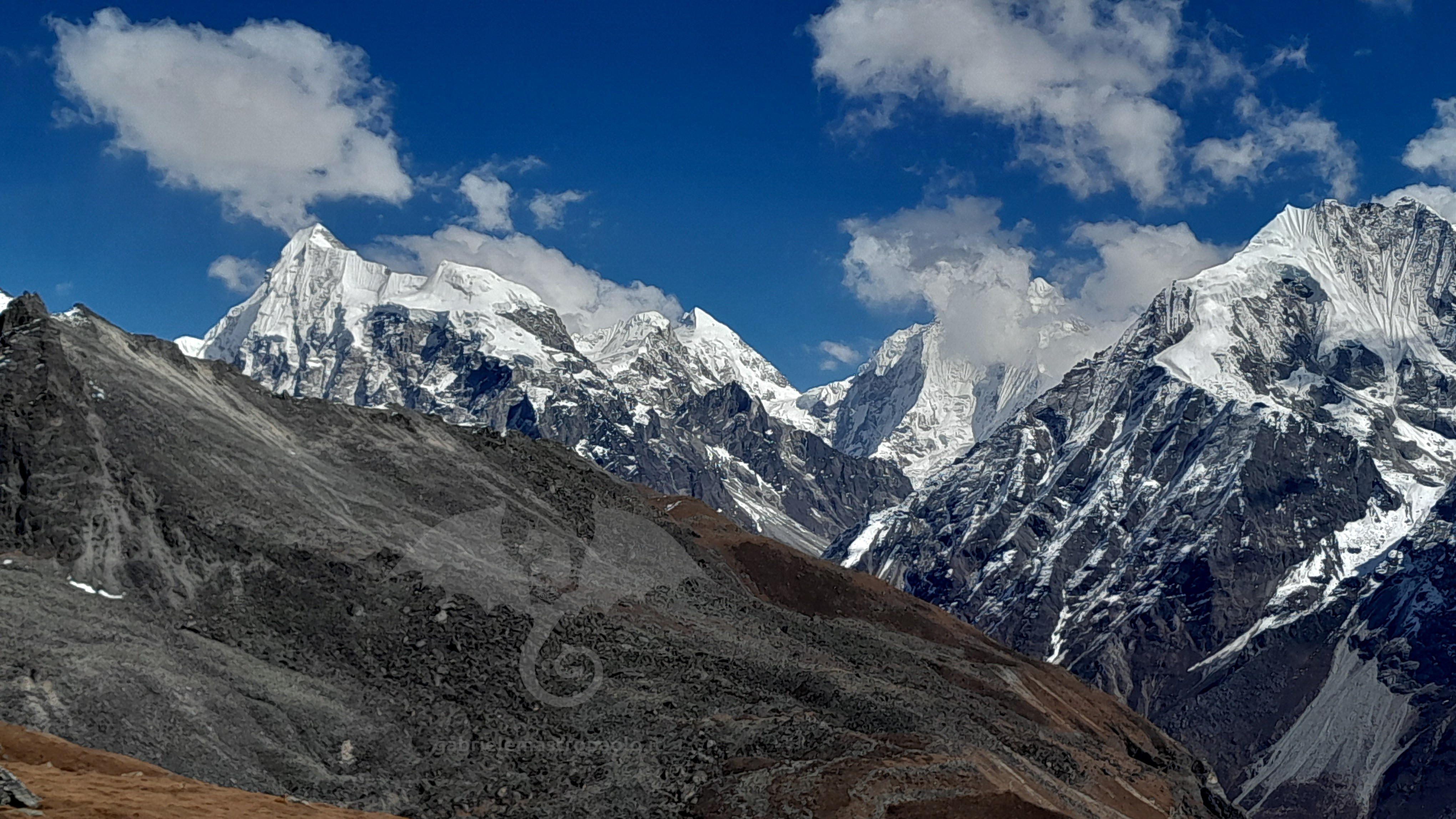
The sun is not yet high but its glare is already touching the top of Langtang Lirung, the highest peak in the entire valley, seven thousand two hundred meters, coloring it pink. The glow hits the valley, slowly the night shroud slips away until it disappears.
I intercept a group of Nepalese. One of them is without a backpack, trusting in the water reserve of his body. Too trusting. We will find him later begging for a sip of water.
The climb is hard. Each step weighs a boulder. My backpack is light, it contains three liters of water, four hard-boiled eggs, a few chocolate bars and crampons for walking on the ice. The top of Tserko Ri is covered in ice. It is a peak constantly beaten by the wind, which increases the sensation of cold and sweeps away the ice on one side of the mountain.
Halfway up the climb I begin to have some doubts, maybe I won't make it. From there I can see the silhouettes that stand out in the sky of those who are close to the summit. I see them climbing, dragging themselves up the last stretch, even steeper, rocky and covered in ice.
The sun now dominates the valley, which lies in the presence of the empire of its light. It's only eleven o'clock, we've been walking for a good six hours and we're not at the top yet. I slow down my pace even more. I need it. My steps are heavy, the ground is strewn with traps, with every step a stone under my shoes, with every stone a loss of balance, twirling with a wand, deep into the ground, calibrating the weight of the backpack, which is as if during the climb someone had fun filling it with clay. Stops every thirty steps, bites of chocolate bars, sips of water.
But I tolerate all of this, no headaches, no nausea. My level of fatigue is limited to my legs, my breathing is holding, in the upper part of my body everything is under control. I have no excuses, I have to continue.
A man with a long white beard, few teeth, dreadlocks, shorts, three layers of jackets on his shoulders. We had met further down during a break, then he had gone ahead. He was gasping. He was mumbling something to himself, probably swearing. We meet again as he goes down, he raises his mirrored sunglasses.
- It's wonderful! - she tells me - it can't be described! Things worth living for! - Her eyes are full of joy.
There's a woman, she's also obviously exhausted, we look at each other, when she's gathered enough breath she tells me:
- There's no going back! There's no going back! - We laugh, then she fixes her steps and continues. A little further on two men will put their hands under her arms and support her.
After an hour we reach the steepest side of Tserko Ri. The path disappears, in front of us only imposing blocks of rock whitened by ice. We proceed on all fours. I stop on a rock, I take my crampons out of my backpack. The first steps are a disaster, I've never worn crampons in my life, I bought them just for my trip to the Langtang valley. Padàm laughs. I tell him to go to hell, in Italian and in English, I show him the middle finger. Padàm laughs louder. A few cold falls, I get up in a bounce, put on my backpack and off we go. The summit is right in front of me but there must be someone behind it who is moving it, there is no other explanation.
We reach the summit.
- Welcome to Tserko Ri-sir! - Padàm tells me, offering me his hand and a bow.
I offer him my hand, then I turn away, I look around.
In Europe the highest summit is Mont Blanc, four thousand eight hundred and five meters, in Italy the highest refuge is Capanna Margherita, Punta Gniffetti, Monte Rosa, four thousand five hundred and fifty-six meters. On Tserko Ri I find myself at four thousand nine hundred and eighty-five meters.
My breathing is regular. I sit. I absent myself.
On the opposite side of the valley, in front of us, the summit of Ganchenpo stands supreme, six thousand three hundred meters, with an imposing vertical wall on whose sides the profile fades violently downwards, with the crests of its glacier drawing straight lines. It vaguely evokes the shape of a ghost, the classic ghost with a sheet, a ghost that watches you and that waits for nothing more than to welcome you with open arms, with the crests of the glacier that fall straight down to act as folds in the sheet.
Further north, a series of peaks plunges towards a plateau covered in snow and ice. Gusts of wind raise enormous piles of snow that immediately become impenetrable blankets. Among those peaks, the Ganja La, a little further on, the Ganja La Pass. During the months before leaving, when I was studying, when I spent hours and hours on maps, videos, itineraries, on my doubts, on my few and shaky certainties, when I was absorbing everything, eager for everything related to those places and those peaks, I had considered the possibility of doing the Ganja La Pass. The Ganja La Pass is classified as one of the most challenging passes in the whole of Nepal. To get there, it would have taken three more days to spend in a tent, with ropes and carabiners. There are no villages in that area, the conditions are extreme. The idea lusted after me. As usual, I bombarded the good Mr Kesh with emails with questions about the Ganja La Pass issue, equipment, timing, costs. The costs would have been very high, in addition to me and the guide, the staff would have been needed for the tents and camp utensils and food. But the measure of how arduous Ganja La Pass was was not given to me by Mr Kesh's emails, it was the YouTube videos that gave it to me, or rather the YouTube videos that were NOT on Ganja La Pass. On the Langtang Valley trek there are hundreds of them, on Ganja La Pass I find three, all short and terrible. There is no way to keep your hands still and brandish an action cam or prop up a tripod for the fixed camera. In Ganja La Pass you need your hands to survive, you have no time and no way to do nonsense. I was almost made up my mind until I thought about it. The weather. The climatic conditions in Ganja La Pass are extreme. October, along with April, is the best month to hike in Langtang Valley as long as you stay at low altitudes. Things change if you go higher. As far as I was concerned, I had already chosen to climb to Kjangjin Ri and Tserko Ri precisely because I took into account the variable weather, if one is overcast, I can always play the card of the other. At Ganja La Pass that variable is a constant.
For the descent Padàm chooses a different route. During the climb I had seen other hikers who then went down, so they did not know the alternative route that Padàm now proposes. It is a longer route of at least an hour of travel but easier. In the mountains the descent is always more treacherous than the climb, Padàm's choice is also a common sense choice. The path winds through meadows with tufts of red and hard and prickly grass, with a series of hairpin bends that then give access to almost flat straight sections that proceed halfway up the hill. It descends undaunted towards the Langtang, marking the north-east side of Tserko Ri. We climbed from the south side, so now we have the opportunity to see different views and to see the Langtang chain in all its development starting from the base, from the bottom of the valley, while climbing we turned our backs on it. While climbing, among other things, we mostly walked with our heads down and watched our feet to avoid missteps. I see a lot of hikers with low ankle boots, which in cases like these is not the best choice, the high collar of the boot guarantees stability and in case of sprains it guarantees greater protection to the ankle.
The Langtang river escorts us from afar with its roar. The outward journey from Tserko Ri was not crowded, on this descent, except for me and Padàm and a few other travel companions, there is not a living soul.
Every now and then Padàm utters a verb, I do not understand if he is referring to me or to the travel companions. I am absent, they are not there.
We intercept the remains of a building, dry stone walls, a building a few hundred years old. Padàm explains that it was used by the herdsmen, they came here in the summer with their yaks, in the winter they moved to the bottom of the valley.
The path allows you to gallop. Among the few travel companions, chatter breaks out every now and then. I lose them until I find the sound of my footsteps on the gravel, the sound of the weak gusts of icy wind, the panting of my breathing.
I intercept the silhouette of a hiker. He is dressed like a bourgeois strolling along the seafront, with a hat and a light sweater. He is Chinese. We exchange a few words. He notices my three layers of jackets.
- Don't you feel hot? - he asks me.
- Don't you feel cold? - I tell him. We smile. We say goodbye. I retrace my steps, my breathing.
There is a fork in the road and there is a solitary pole with a rickety sign, the paint smudged: 'way to Yala Peak, 5600 m.'.
We arrive at Kjangjin Gompa at 5 pm.
In Italy, for an eighteen-kilometer loop with eleven hundred meters of altitude difference it takes me five hours. Here it took me twelve.
The next morning everything is white with snow. The sky is covered with thick, pregnant clouds. On the surrounding peaks, including that of Tserko Ri, there are blizzards. Anyone who had planned to climb today will have to give up.
I was lucky. Very lucky.