

 October 24, 2024, day 8
Direction Thulo Syabru.
Thulo Syabru is located at an altitude of two thousand two hundred meters, lower therefore than that of Lama Hotel which is two thousand five hundred and fifty, a minimal difference. It would seem like a not very steep descent, in reality it is a difference: you must first descend to an altitude of one thousand five hundred and then go back up to Thulo Syabru, the total exceeds one thousand five hundred positive meters. But the body is now trained, it is as if by default my body had engaged a gear until that moment unknown to me.
We descend in altitude, therefore. We reach Bamboo but this time no lunch, we allow ourselves a stop for a fruit juice. Near me there is a pipe from which cold water flows, from which I am granted a little refreshment by rinsing my vow and arms. A little further on a man swings on a plastic chair with a child in his arms.
- Can I take a picture of you? - I ask.
- Yes, - the man answers me. He sings. The child watches me curiously.
We continue our journey. A wooden sign hanging from the trunk of a tree says 'Pairo Hotspring', a thermal spring. I don't mind a nice hot bath.
- Let's go, - I say to Padàm.
- It's on the other bank-sir, the bridge is closed at the moment. -
- Patience, - I say.
Padàm signals me to look up, on the other bank of the river, on the rock walls overlooking the river there are large yellow blades. They look like slabs of rock hanging in the void.
- They'll fall into the river soon, - I say.
- It's honey-sir, - Padàm corrects me. Each of those slabs couldn't fit inside an entire refrigerator.
The usual coming and going of chattering hikers and techno music blasting from Bluetooth speakers. Sherpas with their impossible weights. A few groups of hikers. The tapping of sticks on the rocks. Every now and then I intercept solitary hikers, accompanied only by their guide. I particularly sympathize with the latter. One of them is in front of me. He proceeds very slowly, has white hair and has irons sticking out from his knees. I follow him but at a distance, I don't want to embarrass him by breathing down his neck. At a certain point he stops for a sip of water and signals me to go ahead. I thank him and proceed.
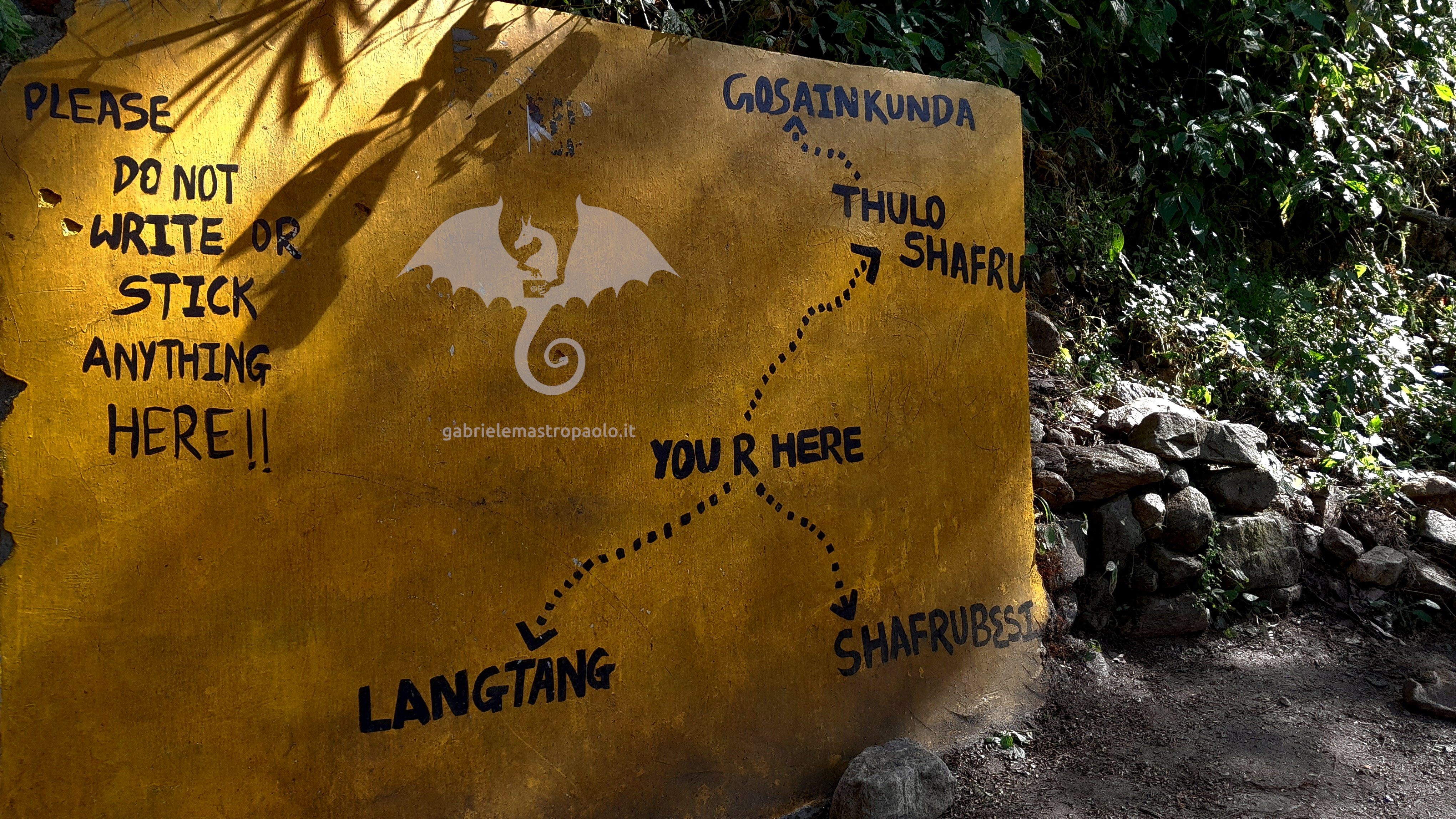
We come to a fork in the road. A slab of rock with a yellow background and English writing shows us the direction to Thulo Syabru. This is where the second part of my journey in the Himalayas begins, Lake Gosaikunda. Gosaikunda - 'kunda' is a suffix for 'lake' - is the largest of five lakes located at an altitude of four thousand three hundred and eighty meters. Hindus and Buddhists consider it a sacred place, not by virtue of a dedication as can happen for a temple: tradition attests to the presence on the shores of that lake of Buddha and Shiva in person. Every year in August tens of thousands of pilgrims go to Gosaikunda and immerse themselves in prayer. The most daring also go in the cold seasons when the lake is almost frozen and still immerse themselves in its icy waters. They camp along the banks. Sometimes someone dies from the cold, but on the other hand they die happy.
I am not religious. I lost the ability to be religious (over time I lost other abilities) when I was a teenager. I went to the oratory, prayed, served mass, lit the censer during Sunday service and incensed the faithful filling the church with smoke. The singers coughed. Then I simply stopped. No mystical crises, no priest who touched me (he was a good person), no traumas. Nothing at all. I just stopped. I stopped when in prayers, catechism, devotion I saw only apparatus.
I certainly did not choose to go to Gosaikunda for its religious character, or just aesthetics. I went to Gosaikunda because, however much one may not believe, where so many people gather in the name of a creed, then it is not by chance. There must be a cause, of faith or not, that justifies the sacredness - real or presumed - of a place. 'Sacred' is an ambiguous word, today it has a positive connotation but in its etymology it means 'separated'. In ancient religions, 'sacred' was the area of the temple where the divinity was located. Only a few had access to that area, it was a taboo, whoever violated that taboo paid the consequences, even in physical terms. 'Sacred' therefore became synonymous with 'cursed'. The concepts of sacredness and danger actually coincided. And I go to Gosaikunda because all of this intrigues me, I am intrigued by the phenomenon for which so many people go there to immerse themselves in its waters at the risk of their own lives.
But after the fork with the yellow-tinted slab of rock I already feel the Gosaikunda effect: the path is practically deserted. The break with the part that ended at the fork is clear. No chatter, no techno music playing, no other groups. Even the Sherpas fade away. Along the path, only the panting of my breath. Padàm keeps his distance, behind, for safety reasons, he tells me, and he is right to do so. When we were climbing up to Lama Hotel, my cell phone almost fell into the Langtang. He retrieved it, realizing that it had fallen out of my back pocket. The cell phone remains incredibly balanced on two thin grass bushes, he lowers himself along the ravine with sacramental caution, holding on to the trunks of the conifers, stretches out his arm and retrieves the cell phone.
We start climbing again.
The path unfolds before us almost vertically, slabs of dark, mud-damp rock stacked one on top of the other like steps. Along the way, generous streams of water gush out from everywhere. Sometimes my step stumbles, I lose my balance but the weight of my backpack saves me from a fall, giving me greater stability. We gradually leave the Langtang valley behind us to turn around the side of the mountain. Around us, the smells of the vegetation, the panting of our breathing, and little else. Silence.
I signal to Padàm to stop. A figure approaches. No, two figures. It is the man with the iron on his knees. He and his guide join us. We exchange a few words.
- Where are you from? - I ask him.
- I am Spanish but I come from Canada. And you? -
- From Italy, - I answer - or rather, from Sicily. -
Our guides fraternize. The Spanish guide lights a cigarette.
- You don't get it at my age - the Spanish tells him.
- I'm fine. We all smoke here - the guide tells him.
- Are you okay? Then explain to me why you do nothing but spit? -
The Spanish is right. It's not just the Sherpas, it's a widespread habit, adults, kids, men, women. They spit with devotion, maybe.
- I'm sixty-seven years old, - the Spanish continues - let's see if when you're my age you can say you're okay. -
The Spanish guide is in his forties.
I look at the Spaniard.
- I have great admiration for you, - I tell him, implying the iron on his knees, - and I agree with what you say. But I also have great admiration for them. - I point to our guides.
- We wear technical t-shirts, technical pants, technical boots, and we have a ten-kilo backpack on our shoulders and we get tired. They have none of this, they wear shoes that we use for the beach, and they climb a thousand meters of altitude with seventy kilos of pack on their shoulders. -
I signal to Padàm to continue our journey.
- You go to Gosaikunda too, - I tell the Spaniard, - we will certainly see each other along the way. Gabriele, nice to meet you. -
- Rey, nice to meet you, - the Spaniard tells me. - I will take it easy. Have a good trip, Gabriele. -
Our steps, wrapped in a mystical silence, proceed with contented slowness. The sun's rays filter from up there, through the crowns of the conifers. The fluttering of birds of prey among the branches acts as a counterpoint to the silence. The physical well-being provided by the movement feeds on its own fatigue. After about two hours, beyond the crowns of the trees, the roof of a small building, a village, protrudes. It seems suspended on the branches, perhaps the home of an emulator of a local Baron in the Trees, in reality it is only an illusion caused by the steep slope. But it is not a village, or rather it is a village but a village with only one house. A couple lives in this house. They are both sixty years old. He is busy sorting the firewood, she is sitting on the floor with her loom. There is a small refreshment area with benches and tables. From the wooden ceiling that covers this area hang handmade artifacts of colored fabric.
- Namaste! - he greets us with a smile.
- Namaste! - I reply. I free myself from my backpack, sit on the bench, ask for a fruit juice.
I observe the artifacts. How much work, how much time to make them, and the two of them, alone in the middle of the subtropical forest, a dot on the side of a mountain two thousand meters high, in the company of a few chickens that scratch with their beaks indifferent to the passing tourists. Beyond the haze, on the opposite side of the mountain and a thousand meters of altitude difference, Thulo Syabru can be seen. Between that house and Thulo Syabro, an abyss.
I ask the woman if I can take her photo. She gives me her consent without batting an eyelid. In Morocco, when someone notices that a tourist is ready to brandish his cell phone, they get agitated and with their arms they make an animated no-no-no sign!, there is a widespread sense of iconoclasm, a real phobia for images, especially for photographic portraits. It is understandable, it is the exasperation of that Western moloch called privacy, halfway between a decoy and a compulsive obsession.
Here in Nepal, especially among the peaks of the Himalayas, they don't even ask the question. Nepal attracts a million hikers every year, seduced by the allure of the mountains, by the stupas with the ubiquitous eyes of the Buddha, by the images of the many-armed goddesses, by the kamasutra, by the holy men in the lotus position. In 2023, about eight thousand tourists walked the paths of the Langtang Valley. They come here, they take photos with the holy men, photos of the panoramas, of the locals cooking, videos of the locals saying namastè, of the yaks grazing, of the pennants waving on the suspension bridges, of the snow-capped peaks. And then it all ends up online, a flood of images that will seduce other tourists, other hikers in love with the East and with hard work. They will put their hands in their pockets and come here, to offer relief to these people who survive with the essentials, who despite everything smile and show no impatience towards life and its burdens.
There is a scarf with two colors, milky white and a pale blue. I like it a lot. I would like to take it. I hear voices behind me, the deep panting of a breath, chopsticks on the rock. It is Rey. He slowly frees himself from his backpack and makes himself comfortable. He too is intrigued by the artifacts. He observes the two-colored scarf in my hands.
- Take it, - I tell him and hand it to him.
- No, you saw it first, - he tells me.
- No, - I tell him, - its blue and the blue of your eyes are a match. It's yours. You found each other. -
Rey tests its surface with the palm of his hand.
- I have a light raincoat, it will look good, - he tells me.
There are some belts, even the brightly colored ones. I'll take one.
I have a second helping of fruit juice, then I get my backpack.
- See you at Gosaikunda, - I tell Rey.
Padàm and I continue our journey.
Once we leave the village behind us, the path continues with a steep descent towards the valley. Down there is a suspension bridge over a river.
- Gosaikunda River-sir, - Padàm urges me, anticipating my curiosity. He is used to it now, I ask him a thousand questions, what is the name of this, what is the name of that. With patience and enthusiasm Padàm answers. Not always. When he doesn't know the name of a certain peak or a certain river he says to me 'I don't know-sir' and I say to him:
- You should know, not so much for me, who ask you a thousand questions, but for the love of your land. You are still in the middle of the most envied mountains on Earth. -
Padàm observes me in silence. Who knows how many things he is telling me, I think. Maybe he is right. I like to tease, provoke.
The descent to the suspension bridge is steep, the path is littered with rocks, balance traps.
I think about Rey, if he will make it. A slow step forward, another slow step, we reach the bridge. It is the most suspended suspension bridge of all the ones I have seen so far, and the longest. Below us, far below us, the Gosaikunda river.
About two hours of walking and we reach Thulo Syabru. I am tired, I need a shower, I am hungry.
A chicken welcomes us to the city. It is standing on top of a dry stone wall and watches us curiously. Another one arrives. Another one arrives. They must have spoken to each other in a way that is completely unknown to me. I try to get closer and they flee like owls.
The village is actually already a small town, with beaten paths, shops, hotels. Just under a thousand inhabitants. I wonder what makes it so organized. Shortly afterward I have the answer: the streets of Thulo Syabru open onto a road that guarantees the passage of heavy traffic. And that's why the crowd of Sherpas collapsed along the road. It is spread out along the side of the mountain, the first houses are at a lower altitude than those at the top. So yes, we arrive at Thulo Syabru but not at our hotel, our hotel is at the top of the hill, a hundred meters above, after a dense series of hairpin bends.
- It's the one up there, the most panoramic-sir, - Padàm tells me with a smile somewhere between amused and sadistic.
- You'll be damned, - I tell him.
The hotel is very welcoming. So is Mr. Rakesh, our host. The room has an en-suite bathroom. It is tiled. There is a sink. There is even a mirror. An authentic European toilet, as only Europeans know how to do. And finally I can shave without holding my cell phone.
There are two beds with fresh lavender sheets and duvets, a luxury that you cannot afford in villages. Sometimes I found moldy duvets and pillowcases but it did not bother me. I wrapped the pillows in my t-shirts. I used my sleeping bag. I chose to take this trip precisely because I relegated comfort to the bottom of the list. The hygienic conditions are precarious and I do not worry about this either. What I am looking for is not a tourist village situation, there the sheets may be clean but everything else is quite dirty. At Lama Hotel I had breakfast with the Sherpas who slept next to me on the bench in the dining room and mounds of duvets that hadn't seen water for who knows how long but I didn't care, that sense of promiscuity, that sense of a precarious life, that sense of 'this is there and this if you want you can take' I liked and I like it. It wasn't a natural state but it's very close to it, an immediate state, without mediation. My room was full of drafts and rotten wooden planks but it was already a lot if I could spend the night indoors. Living and surviving on the essential. Minimalism.
I take a long shower. I shave. I get dressed. My movements are very slow, not so much because of the tiredness, which has melted away with the water, but because of the slow flow of my being, the slow acquisition of the state of grace, the state of absence.
There is a large window overlooking the valley. It takes my breath away. So many little houses scattered on the sides of the mountains. Terraced fields. Far away, in the middle of the forest, which feels a lot like no man's land, a tiny, white dot. It is the house with the woman who spun scarves and belts.
I take advantage of the sink to rinse t-shirts, socks and underwear.
I allow myself three dinners in a row: momos, roasted potatoes, chowmin with vegetables, and beer. I dine outside on a large veranda overlooking the valley. We are at an altitude of two thousand two hundred but it is nice outside. Besides us there are only two other guests, a noisy Sherpa and a woman.
After dinner with Mr Rakesh we have a long conversation: the Himalayas, the hard life in the mountains, Italy, Sicily, the sea, politics.
I tell him:
- You have had devastating floods, I read that your prime minister gave up a month of his salary to make it available to the displaced, and so did his advisors, they gave up a week's salary each. -
- Propaganda, - comments bitterly Mr Rakesh. - Corruption. The levels of corruption in Nepal are at very high levels. They take advantage of the poor people. In Italy you are better off. -
- Dear Mr Rakesh, not all that glitters is gold, in Italy we have as much beauty as corruption. -
In the days before I was already asleep at 8 pm, tonight I go to bed after 9 pm.
I fall asleep immediately. I will sleep all night like a log. The well-known exhibitionism of my sciatic nerve that night did not occur.
The next morning, wake up at 5, at 6 I have breakfast, pancakes with honey and ginger tea. I pick up the stuff hanging out to dry, settle the extra bill with Mr Rakesh, pick up my backpacks in the room, and off we go again. I will forget my trusty red jacket amidst a thousand curses in extinct languages, I will realize this only when we are almost at Sing Gompa, our next stop on the way to Lake Gosaikunda, the lake of Shiva and Buddha.