

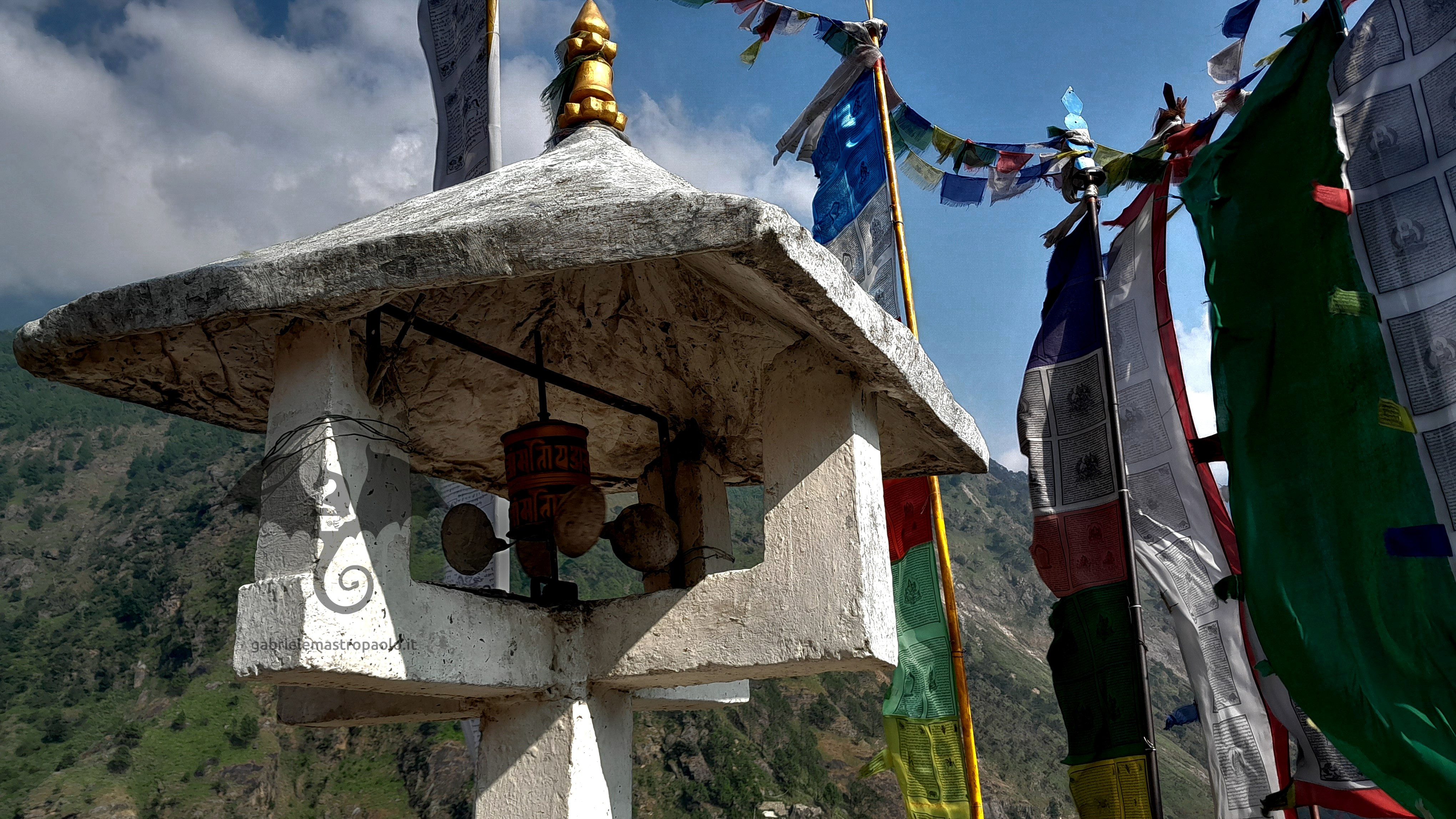
 The guesthouse is buzzing with festive air. In the hall - actually the dining room - there is always a coming and going of people leaving and people arriving, Namaste! Namaste!, the seats at the tables occupied by bulging backpacks; it is not just the gear - the technical equipment - that bulges, the backpacks overflow with expectation, amazement, wonder.
They serve me lunch, naturally a dalbhat. Padàm hands me cutlery, napkins and food. I watch him.
- Thank you, - I tell him - but you don't have to be so thoughtful, just do what I ask you to do. You are my guide, not my servant. - He thanks me and says nothing more, he will do this throughout the trip. There are other people in the room with me and there are other guides. The other guides do the same, they act like servants, like Padàm. Then I understand, and I understand that I don't want to understand. It's not just the hospitable nature of the Nepalese, serving guests is typical of guides. The fact is that they are not just guides, they are the real organizers of the trip, they are the ones who make the reservations, they are the ones who decide where you sleep, where you eat, above all to make you as comfortable as possible. In the hospitable mentality of the Nepalese, the concept of making your guest comfortable includes that of being his servant. Probably, in a cultural and unconscious substratum, there is also some form of reverence towards the European man, the European who brings money. This upsets me. I don't want a servant, I want a guide. But it's a lost cause: all guides do it, for them it's work, a guide who didn't do it would be disqualified, out of the loop.
At dinner, the festive atmosphere takes shape in a Sherpa dance accompanied by Padàm's harmonica, which pours into a traditional piece. At the large table, guests from Singapore celebrate their return from the trek in the Langtang Valley. They get drunk. The beer flows in pints. The words get longer. The atmosphere is light.
At my table I am alone.
- You're not having dinner? - I ask Padàm. - Sit with me. -
- I'm having dinner with the Nepalese, - he tells me. He segregates me, I conjecture. My guide segregates me. But I'm wrong. I'll understand it later, or maybe I won't understand it or maybe here too I don't intend to understand. This phenomenon will repeat itself every day, every lunch, every dinner. Padàm is ashamed to have dinner with me because he eats with his hands. He doesn't tell me this openly but his embarrassed refusals to my invitations to have lunch at my table let me understand it. I look at his fingers, very short nails.
- Why do you have such short nails? - I ask him.
- We Nepalese eat with our hands, if we had nails like yours the food would stay under the nails. You eat with cutlery. -
In the morning, breakfast for those leaving; at 4 the kitchen is already operational. Sleepy in my room, the aromas of spices and the hushed voices of our guests reach me. During the night, the exhibitionist sciatic friend comes to visit me, punctual for a year now. He makes an effort, he wants me to listen to him at all costs but I don't give in. I still manage to sleep six hours of intense sleep. A personal record for me, given the standards of the last twelve months. Also thanks to the bed, a thin layer of soft foam on a rigid wooden bench. On a rigid one, the road is uphill for the exhibitionist. The question of the sciatic nerve is one of those that I racked my brains over most during the preparation phase. In that year in his company, the nights were punctuated by his presence. It manifests itself only at night, during the day my movements are completely free. At night I can do two, three hours of continuous sleep, then it's all about doing somersaults on the bed, getting up, walking, doing postural exercises, but the nerve wakes up and there's no way. I fall asleep again only because I collapse, tired of trying to find a comfortable position. How will my sciatic friend behave during my stay in Nepal? In those twelve months I did not deprive myself of excursions, the nerve did not manifest itself even in the most critical conditions, but walking on rough paths and significant differences in altitude for a single day is something very different from tackling a journey of one hundred and forty kilometers for twelve continuous days with an average of a thousand meters of difference in altitude, not counting the rarefaction of oxygen. The highest point of my journey, Tserko Ri, is located at an altitude of four thousand nine hundred and eighty-five meters. At that altitude, the oxygen is fifty-five percent. Altitude sickness, the sensation of physical exhaustion due to the rarefaction of oxygen, can manifest itself already at an altitude of two thousand with headaches and nausea, in the worst cases with embolisms.
I consider myself tested for altitude three thousand four hundred, the summit of Etna, the Sicilian volcano, where I was a year ago without any problems but even there it was a one-day excursion, and above all I did not sleep at that altitude. In Nepal already on the second day I am at an altitude higher than two thousand meters, and the first two days of walking await me a little less than forty kilometers for a total of two thousand meters of altitude difference, with a ten-kilo zino on my shoulders, and the night's rest compromised by a heavy unknown. Will I make it? I have no idea. And after all, the question is in my plans like cabbages at a snack.