

PREMISE
It's the story, not the teller.
Stephen King
This story does not pretend to be useful to those who may decide to go to the Langtang Valley, there is no shortage of useful information on the web. This story does however pretend to be original, not the usual flood of fish-eye videos from GoPros and action cams, not the chattering chatter of those who film themselves with their arms outstretched against the white backdrops of the Himalayan peaks and Tibetan suspension bridges, not the worn-out egotism of those who, while taking a photo of Everest saying how beautiful it is, actually take a photo saying how beautiful their own belly button is.
The story is accompanied by images and videos but they are only ancillary furnishings, the text prevails over everything, in my story the words and their evocative power count. I wanted to tell a story made of stories. I told my experience with the deliberate and arrogant intention of putting aside my ego as an observer, tourist, European hiker to give space to what was around me, to what lived me, and to its dignity. I focused on the evocation more than the description, I deliberately avoided imaginative adjectives and absolute superlatives. As for me, the text is completely absent from that treacherous and disgusting and vulgar word that in dictionaries corresponds to the lexeme 'I'. G.M.
An experience is never its news item.
An experience comes to life before it even begins, before we ourselves realize that set of ideas, suggestions, volitions, expectations, objectives that make it possible.
You don't live an experience, you are lived by an experience. An experience is like the invocation to the Muses, a possession, a set of vibrations by which you feel shaken, manipulated, wanted, used, torn to pieces, pieces then put back together in a new order, totally unexpected, unforeseen and unpredictable, an order of which we ourselves who live that experience, who undergo that possession are nothing but useful instruments. A possession like a massage by unknown hands that involves body, mind and spirit.
An experience is urgent. Once it has entered us, we have no other choice: we must live the experience.
My experience in Nepal begins in March 2024. I return from Morocco, a trip that only amused me, almost devoid of depth except for those rare times when I managed to carve out isolated spaces for myself, far from the crowd.
I therefore return from Morocco with a sense of radical insufficiency, of deprivation, of inadequacy. I have not been in Morocco, I have been in photographs of Morocco. A truly virtual Morocco.
I have been in Morocco without the experience of Morocco, which remained distant from me like a threat. Threat in the sense that not the experience for me, but myself a threat to the experience. As if I had not been worthy of its possession, as if the experience had snubbed me, not finding in me a passage worthy of expression.
And so I return from Morocco hanging in the void. I stagger in the void, suspended in an abyss of inconsistency. I cannot see the bottom of that abyss. I am an orphan of an experience. I am an orphan of myself. I went with the intention of losing myself, of losing myself once again, of forgetting who I am, of letting go of that sack called Gabriele, and instead that sack is always with me. I did not return from Morocco an orphan of myself, I returned an orphan of my absence. The essence of me is my absence.
In a feverish state, still with suitcases to unpack, with the scents of the essences of Marrakech on me, I go to a search engine and type the prompt 'nepal', data and photographs pop up in quantity: Reinhold Messner, climbers on Everest, institutional sites, the story of Walter Bonatti and K2, stupas lost in the valleys with strong flags, vertiginous snow-capped peaks, exotic names. Except for fame, all this is unknown to me, the clue to the skein is hidden in that myriad of details and ideas, arduous research but one thing I already know: I will leave alone. Among the photos and videos I find, the excursions to Everest Base Camp, five thousand three hundred meters, Indian lines of hikers like at the shops of a shopping mall, people jostling sitting at the outdoor tables of the villages at high altitude to take a selfie, to chat, spreading their arms on white peaks, loud shouts like at the national team match, a chattering manner of useless chatter about beauty. All this offends me, disgusts me, repugnants me, disappoints me, does not interest me. Too dispersive. The risk is the dispersion of my absence, diminishing my absence. An experience at Everest Base Camp would entail the risk of disapproval, of deprivation, the disappointment of an experience, the consequence of a non-possession, a non-song, a non-disenchantment, a song completely out of tune, an intolerable disharmony of noises, the abysmal din of my presence. A horror.
But I need a point on which to leverage, on which to rest the world, on which to give substance to my absence.
I have to find someone who will lead me to where I can finally not-be. And this someone must be indigenous. No Italians, no groups, no exchanges of words like where are you from, oh for me it's the third time, oh, I've been to the top of Manaslu, and me then? That of Everest, I met Messner, a great one, people died up there, but you know, oxygen, I'm a vegetarian, at night there can be imbalances, no, for me it's the first time and blah and blah and blah.
No bullshit.
Only the escalation of my amazement. Only my breathing. Only my footsteps on the gravel. Only my panting.
A man from Nepal is needed.
Then the agencies. But there are a plethora of agencies.
The itineraries. A plethora of itineraries.
The details. A plethora of details.
Advice on equipment. A plethora of advice.
Guarantees of breathtaking views. You'll understand, in Nepal.
A wealth of information that makes everything seem the same, the agencies the same, the itineraries the same, the details the same.
I read and reread the documentation on the sites hundreds of times, I make comparisons. And the differences emerge.
Same itinerary, different costs. Very different. What is it, you have gold teeth and those others don't? Oh, here, the welcome, you come and pick me up at the airport and when everything is over you come and drop me off. But look, there's also the room in Kathmandu. Yes, fine, but those others there also give me a room in Kathmandu and welcome me, so what? What's the catch? Wait, what is this? What does 'public trek' mean? And why does it say 'private' there? And then look, see how rabbits jump out of the hat? Minimum two participants, but there's a problem: I want to go alone, I want to be ALONE. So what do we do? You get carried away. I get carried away.
So, let's take stock: you can go in a group or alone, if you go in a group you pay less. Oh. Yes, and not only that: you can choose the type of your trek, public or private, that is, you can choose to join a package of preferences or customize your trek.
Now it's clear.
And of course, mine will be a private and single trek, and who cares about the prices. OK, but the problem remains: there's a mess and a bag of agencies here, who should you trust? Who knows them?
A friend saves me. He lives in Trentino and has a friend who is in Nepal right now, 'get in touch with him, - he tells me - you can find him on social media'.
I look for him on social media, I find him, I write to him. And he, with a stick in his hand, a backpack on his shoulder, with the snow-capped peaks all around him, replies: "Look, I'm with them, I'm happy. The owner is a good guy and has fair prices. Don't worry".
And finally, the one who will be 'my' agency comes out.
He is doing the Annapurna ring. Annapurna is one of the Eight-thousanders.
I read up. I like it.
I see shots, I put up with videos. I'm excited.
I read the technical notes on the sites that offer it, he's already got me, I want to do this trek.
I see other shots and other videos, I see Indian lines like at Conad. It's out of the question.
No Everest base camp.
No Annapurna Ring.
Too bad, I even liked the name but too many decoys.
Wait, there's that one, what's it called? I can't remember the name, you saw a video, very well done, eh but it's a long time old, it doesn't matter, help yourself with the chronology, it's true, the chronology, then someone says social media. So, I scroll scroll scroll, back back back, not this one, not that one, not this one, not this one either, no, not this one either, this is a film, this is a documentary, the war in Ukraine, the elections in the USA, the government's maneuver, Fellini's films, Nino Manfredi, Red Desert by Antonioni, where the hell is it, I don't remember when I saw it... here it is! Manaslu circuit! Manaslu!
The mountain of the spirit. This is its meaning.
I go back to my agency's website, I type the prompt in the search engine box inside the website 'manaslu'... and here the itinerary appears.
Splendid photos.
Beautiful places.
The welcome: there is.
The room in Kathmandu: there is.
The advice on what to bring: there are.
Fantastic, everything is there.
It's him, it's my trek.
By the way, private group. Perfect.
Participants: minimum two.
What do you mean, at least two?!
Well, the Manaslu region is on the border with Tibet, special permits are required and in order to protect the local ethnic groups, only groups with a minimum of two participants are allowed. Translated, no treks only.
Nonsense! The guy in the video was alone!
Well, that's what he wanted you to believe. Go and look at the details under the video.
Sure, I'll go and look.
The details refer to the official website of the documentary's author.
I browse the official website of the documentary's author.
He explains everything to you. And he also explains that you can't go alone.
Come on, let's see other agencies.
Nothing. All the same. All at least two. The Manaslu region is on the border with Tibet, special permits are required and in order to etc etc etc.
No Everest Base Camp.
No Annapurna.
No Manaslu.
 All right, it's time to ask for clarification directly from the owner of the agency, my agency, Himalayan Mentor.
More than clarification, an entire power plant. Between me and Mr Kesh, as the man signs himself, a dense correspondence is triggered.
Entire months of writing to each other.
Detailed questions, mine.
Equally detailed answers, his.
Every day, a different question.
Every day, punctual, his answer.
One hundred and forty-four emails in total, not counting the attachments. A book.
From April to October, right up until the departure.
And so I finally make my choice: Langtang Gosaikunda.
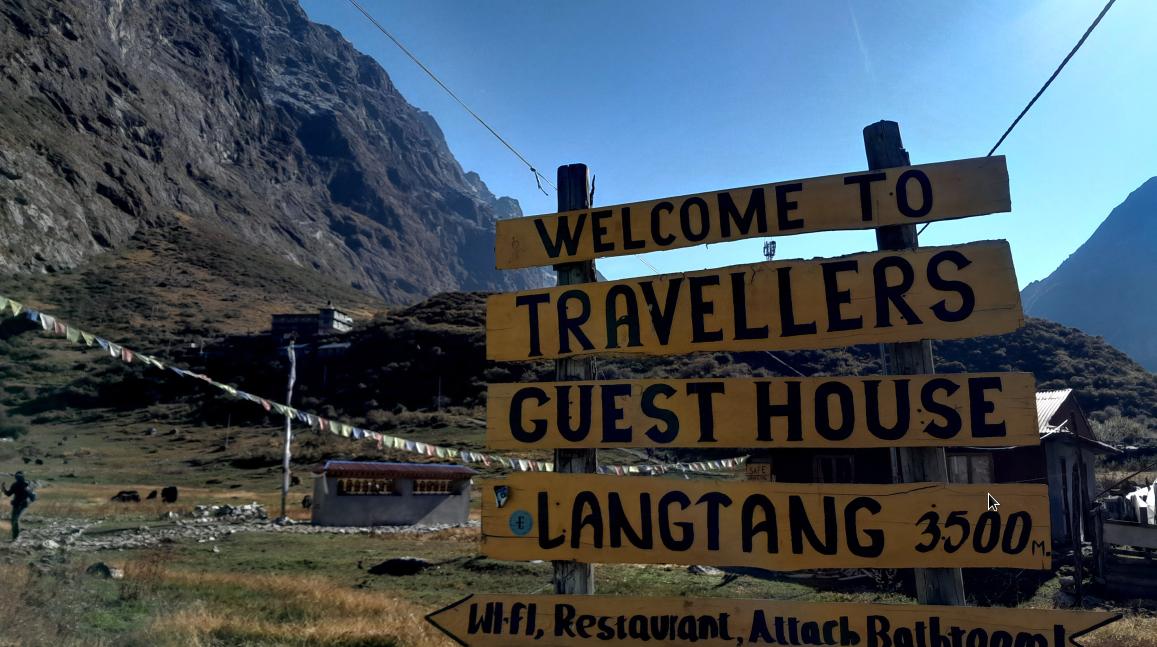
The Langtang is a rushing river that gives its name to the entire valley. The valley winds north of Kathmandu, skirts the border with Tibet and covers a vast area that includes the subtropical forest at the lowest altitudes up to the glaciers of Langtang Lirung, the highest peak in the valley, seven thousand two hundred meters above sea level. The ascent of the river allows you to come into contact with the most varied registers of biodiversity, until the vegetation, with a very thick undergrowth and tall conifers, fades onto the living rock, at an altitude of three thousand five hundred. It is at that altitude that the peaks whitened by perennial snow begin to guard the valley. From Langtang Village the mountain ranges open like a curtain, as far as the eye can see. The names of the villages all sound in English, in reality they are declensions depending on the guests, the signs at the entrance to each village bear the proper Nepalese name under the English one of the facade.
When I make my choice, I start to gather information about what awaits me: if before I consulted hundreds of agency websites to glean as much information as possible about the itinerary and prices, now I return to those websites with a more refreshed spirit but with the greed of the burning heat of the desert, driven by the need to absorb everything, everything about Langtang Valley and its villages, the peaks that tower over it, the nature of the routes, the differences in altitude, the slopes, the views, the details, the suspension bridges, the local people. From agency websites I move on to videos on YouTube. I create my own playlist with all the videos - ALL - on the platform relating to Langtang Valley. In reality that playlist, even though I had intercepted all the videos about Langtang Valley, cannot be exhaustive: every day I find new videos from users who have already been there and who publish their vlogs. This makes my research activity even more frenetic and my curiosity even more avid. And my dreams are more ethereal and volatile and voracious. My imagination soars higher. I fly high like an eagle, and like an eagle that spots its prey hundreds of meters below and dives headlong, I turn my gaze and catapult myself onto the unseen detail, onto the glimpse, onto the peaks that those videos I have already seen dozens of times have overlooked.
When my thirst is satiated with panoramas and views and snow-capped peaks, I focus on the practical aspects.
It is quite a difficult thing to sort through many of those videos. One, two users at most have managed to put together documentaries of great charm, with a sense of history and a lot of talent but they are professionals, people equipped with tripods and high-quality technical resources and experience.
For the rest, poor material, amateur like school trips, with many faces, loud laughter, many selfies, a lot of joy and very little else, in which the compulsive spring of chattering covers everything else.
In the vast majority of cases it is material shot with action cameras, which means wide-angle lenses with the so-called fish-eye effect that tends to distort the image.
Nevertheless, that material like that is useful to me.
Sometimes it happens that the user frames the path, then I watch the same video dozens of times, dwelling on the details, back and forth, back and forth.
Or on the food. What do they eat in Nepalese villages at four thousand meters above sea level? The answer is also in those ramshackle videos, and so down to watch them dozens of times: dalbhat, fried rice, fried vegetables, cholapati, omelette and many varieties of tea.
 Food. Better yet, a rational organization of food intake, that is, a diet. I had to equip myself with a diet. I have been a vegetarian for years but if I can act better on my diet, I have to do it.
I act on food but also on the body. That is, training and checks.
Checks first of all on myself, on my own body, on the levels of physical effort, on the levels of stress and even on the levels of pain tolerance. As Mr Kesh rightly observed in one of his emails, it is one thing to do twenty kilometers of a route at fifteen hundred, two thousand meters, but quite another thing at four, five thousand meters. At those altitudes, the rarefaction of oxygen is the real problem.
And who has ever been at four thousand, five thousand meters of altitude? I consider myself tested for an altitude of three thousand four hundred, the top of Etna, where I was the year before and where I did not feel anything except normal physical effort.
Four thousand. Five thousand. Those numbers whirl before my eyes like delirious dervishes. They fascinate me like siren songs and at the same time instill in me a deep, deep-rooted fear. I have been to the Grand Canyon and crossed the Arizona desert in perfect solitude but I was still on 'consecrated' ground, if something happened to me I would find a place to rest but in the peaks of the Himalayas? Up there it is easier to find a dwarf palm than a doctor. In that area, in the Langtang valley area, the highest town is Dhunche, two thousand meters, the rest are villages with few inhabitants and I would have moved higher and in much more remote places. Kjianjin Gompa, the most remote village, is located at four thousand meters and the closest town, Syabrubesi, is three days' walk and two thousand meters lower. The awareness of and on my body must be total.
From there, beyond my control over my own body, the medical checks.
Despite having been hiking for years, I have never had any specialized medical checks before, in total trust in my body: no electrocardiogram, no spirometry, no eco-doppler, no hemokinetics however, as a blood donor for several years, I have always monitored my physical balance with the medical reports that I periodically receive.
I decide to undergo a cycle of specialized checks. Between the bureaucracy and the downtime and the actual auscultations of my physiology, the former win. The latter give me their go-ahead. My body is ready.
The departure date is approaching. Summer is coming. It is so hot. The muggy heat tightens the esophagus, nevertheless I do not deprive myself of constant and necessary training: many excursions, many kilometers under the scorching sun and the relentless sirocco of the Sicilian summer. To stem the heat, I dedicate myself to excursions in the late twilight: necessity meets the nocturnal charm of the summer sky and its stars, with the lights of distant villages perched on the hills, sparkling flashes that amplify the space and silence around, a mixture of smells and sounds and sensations that deepen the expropriation of the self, the constant release of absence from one's mind and spirit, a release that lightens the body.
June passes. July passes. August passes. We reach the end of September.
While rereading the news and reviewing the videos on Langtang Valley, a notification from the platform gives me some news: on September 28 and 29, Kathmandu is devastated by torrential rains, rains that cause the flooding of the Bagmati River that crosses the city. Result: two hundred and forty dead and four thousand seven hundred displaced. It is a national catastrophe, never like this since 1970. Landslides everywhere. The entire area around the city is an open sewer. Debris and carcasses of buses and cars and human bodies dragged by the fury of the mud currents. All the main arteries that connect the city to the rest of the country are blocked by mud and collapses. For three days, life in the city and in the Bagmati Valley is paralyzed. Slowly, the civil defense and the army get to work first of all to recover the hundreds of missing people, then to restore regular traffic to the main roads. The circulation of goods, especially food, is collapsing, prices are soaring by ninety-five percent.
I read all this with shivers. And resignation. My departure is set for October 16, my trip is naturally compromised. Patience, I tell myself, I can only hope for luck, with all those deaths, then there is little to hope for. But I overlooked an important detail: Durga - Khalì, the goddess who symbolizes the triumph of good over evil, consort of Shiva, one of the most important of the Hindu pantheon. And I overlooked Dashain, the most important religious celebration of the Hindu calendar dedicated to Durga - Khalì, a celebration that every year moves millions of Hindus and is held in the first half of October. This year it is scheduled from October 3 to 14. It has the flavor of Christian Christmas, it is the celebration of the domestic hearth, in which Hindus leave the city to reunite with their families in the villages. The celebrations for Durga - Khalì accelerate the work of civil protection and the army on the roads. The main arteries that branch out in all directions from Kathmandu are gradually being returned to traffic.
Contact Mr Kesh, my agent in Nepal: Dear Mr Kesh, Namaste! What is the situation in Langtang Valley, thank you for your email, sir, the situation is calm, a group has just returned from there, the roads are as before the floods. Your trek is safe.
My trek is safe. Langtang Valley is safe too, at least this. In 2015 it was devastated by an earthquake that razed entire villages and caused hundreds of deaths among tourists and natives. This time Durga - Khalì has done mercy.
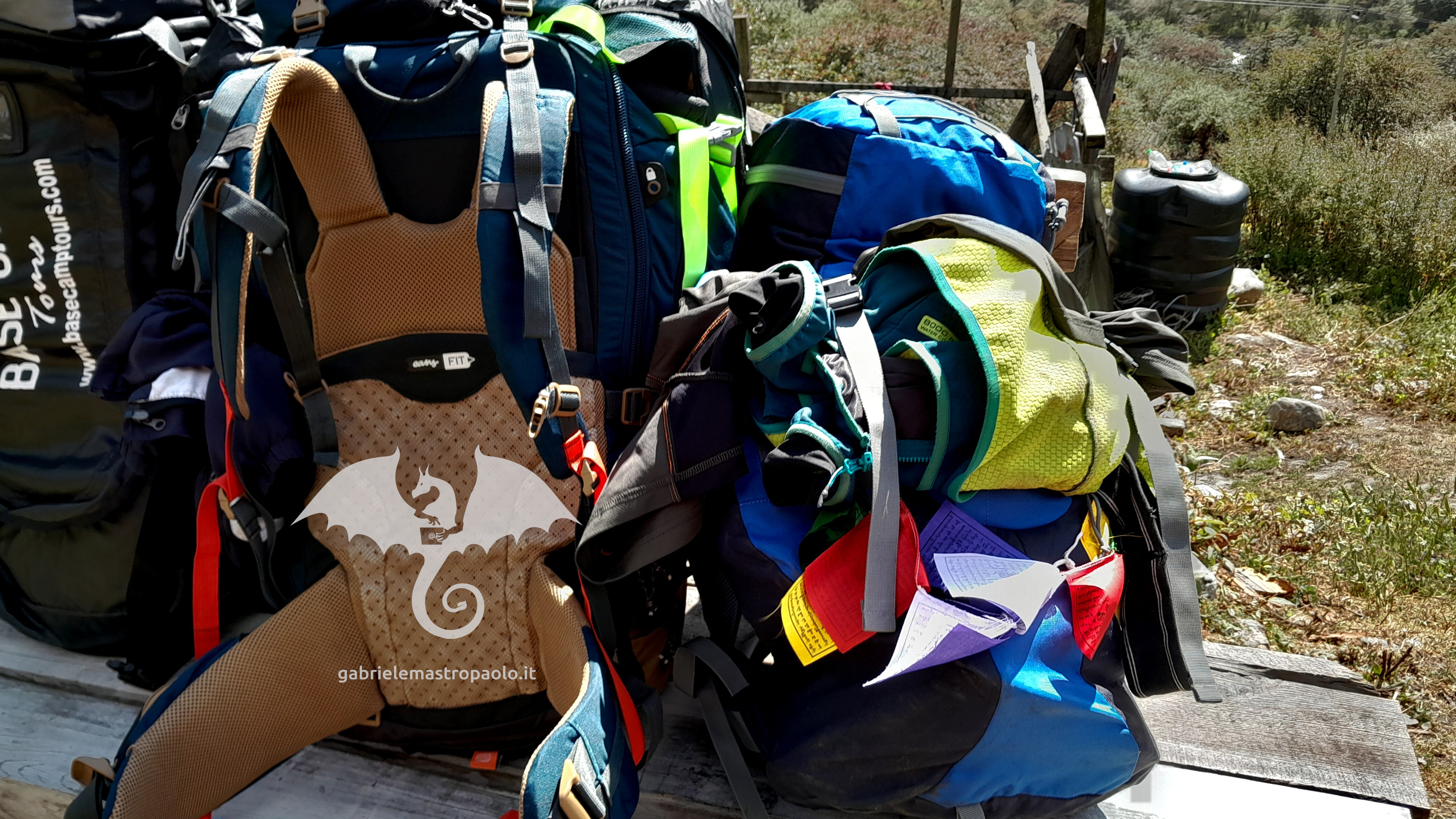 I dedicate myself to the backpacks. Two backpacks that I have already packed and unpacked dozens of times, more than a necessity, an exercise, in any case a necessary exercise: to calibrate the weights, to distribute them in the most optimal way possible between the backpack that my Sherpa would have shouldered and mine, and above all, to let go of the useless stuff. I have to survive for fourteen days among the Himalayan peaks, I will walk for one hundred and forty kilometers and cross a valley where biodiversity is the rule, from the subtropical forest to the glaciers of the Seven Thousand, so twenty kilos in total, including water supplies and the weight of the backpacks themselves are inevitable.
Among the many users who post videos of their experiences in Langtang Valley I spot one in particular of a Californian girl who went in spring with her sister, I ask her a few questions: how far is it from Kjiangjin Gompa to the top of Kjiangjin Ri, and what are the temperatures, she answers me almost immediately hello, you have to consider the period in which you go, look, I'll go in a few days, you were in spring, I imagine that the temperatures will not be much different, sure, yes, cover yourself well, I found - 5 °C which can also be lower, at the top of Kjiangjin Ri and Tserko Ri it is always very windy, ok, you are kind, thank you very much, hello, have a good trip (face with smile and hearts).
 October 17, 2024, day 1
The flight leaves from Catania. I stop in Dubai for a few hours. I arrive in Kathmandu the next morning. During the night I can sleep even sitting up. In that position my dear friend sciatic nerve is quiet in its corner. He is an exhibitionist, he has been coming to visit me for a year now, sometimes discreetly, sometimes with a racket that does not leave me in peace. When he is really in the mood, the pain takes over. I promise myself to undergo a check-up once I return. For now he has to deal with me.
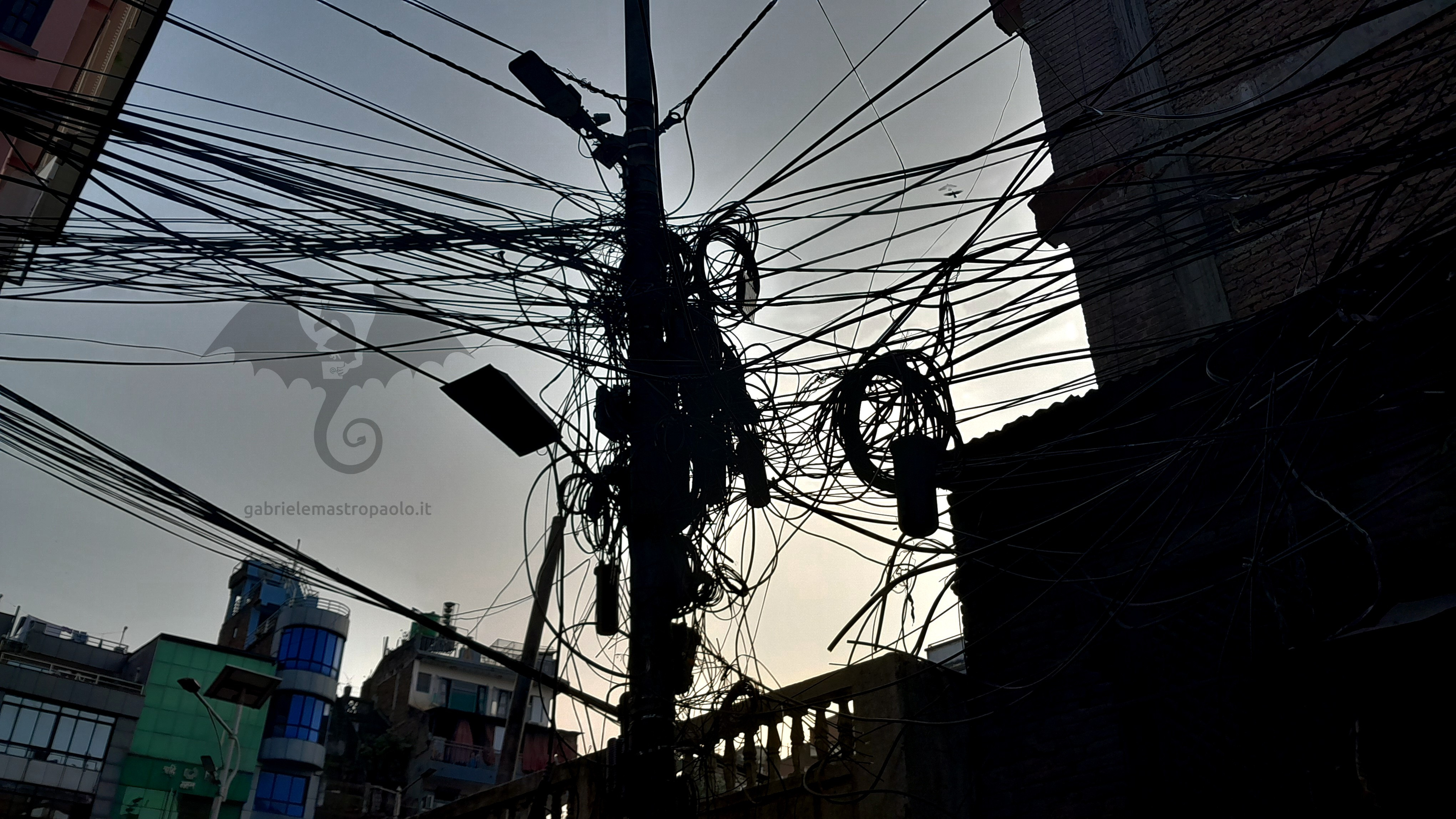
I unpack what I need for a long hot shower, then meet in the hotel lobby with my guide and Mr Kesh. My guide, Padàm, is a little man with eyes that smile instead of a mouth, he looks like a cartoon, animated by the typical affability of the Nepalese. After exchanging the necessary pleasantries, I say goodbye to my hosts and dedicate myself to her, to the city. Kathmandu reciprocates with the exuberance of a suffocating embrace: to say that it is chaotic does not do it justice, if only it were only chaotic. There are no sidewalks, cars and mopeds appear everywhere and slip in everywhere, as if nothing were happening you find a taxi under your armpit. Cars speed in every direction, smoke and dust filter the air in a cloudy dust effect. But the enchantment of the city prevails, like a voice telling you 'go beyond what you see, concentrate on what you feel'. And I see colors and I smell, the colors of the fabric shops and the smells of the essences. Every shop has a lit incense stick. The fragrances stun more than the chaos of the cars, but I also hear voices, soft voices, whispering something to me that is not immediately understandable, perhaps because of the traffic, perhaps because of the mysterious charm of the city. Then I understand: they are the whispers of the barkers, men who approach you discreetly, point at you, stare at you and talk, and promise you women at easy prices, massages, stimulants, everything near you, only on the third floor, see? Come on, sir, take courage, it costs little, sir, women, sir, good stuff, sir. Sir.
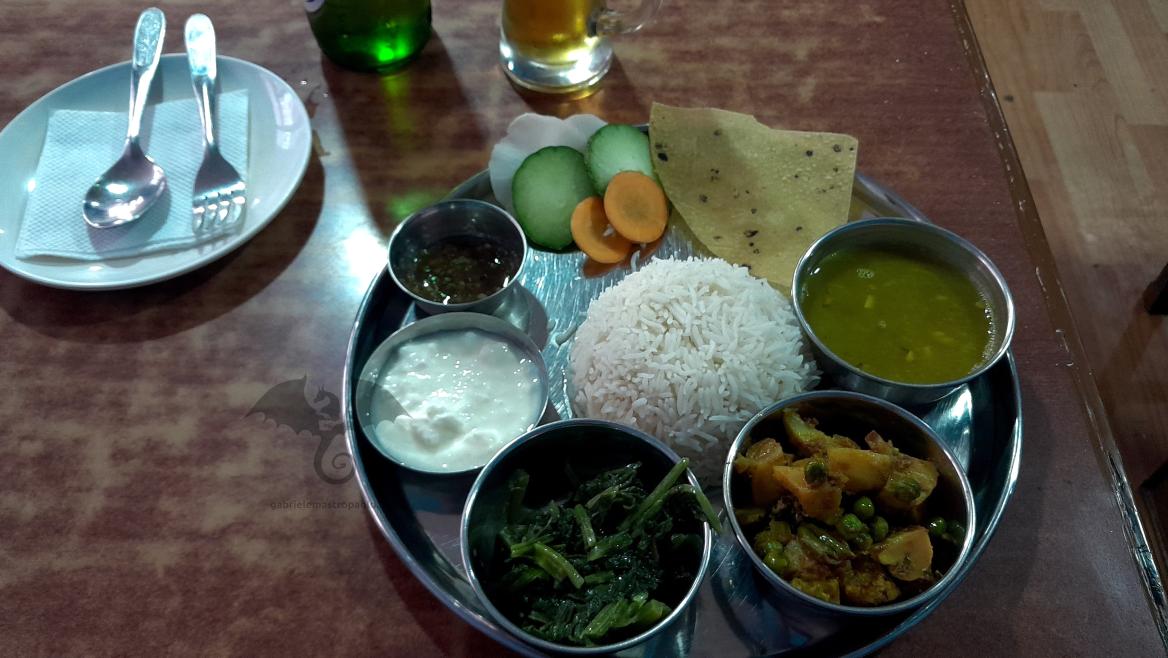 The fact is that I'm hungry. I'm looking for a place to eat my first dalbhat in sacred land. It's full of delis, more or less assorted, more or less dirty. I see a sign, "international cuisine, first floor".
Good, I tell myself, at least I'm away from the traffic. It's an all-wood building, there's a room with ten seats or so, and it's deserted. Bad sign, I tell myself. Not if you consider that it's five in the afternoon. It's all or nothing.
And it went, the dalbath is good. After lunch-dinner, I recover my embrace with the city. I walk with a certain lightness of spirit, I cannot allow myself any other kind of lightness, my body is bound by the sprawling traffic. Never was a metaphor more appropriate: the traffic of Durga - Khali, the goddess with many arms. A guy sticks to me. He is a boy of not even twenty, he speaks a little Italian. Yes, he sensed that I was Italian, no one knows from what but he sensed it. He talks and talks. Of course I will have to fork out a tip later but since he is good as an improvised guide, I let him do it. He leads me into the heart of Kathmandu, narrow streets with a temple for every dog piss but the dogs here probably don't piss, they are very calm, they sleep all the time, zen dogs that dangle indifferently between motorcycles and human beings, lots of dogs that sleep lying on the edge of the road when taxis and SUVs and buses pass them by a few centimeters away. I start taking some photos: a temple, the eyes of Buddha on top of a stupa, the relief sign of a junk shop, at the entrance of a temple there is an individual in a wooden relief with a huge phallus who masturbates, there are two who are fucking satisfied, there are others who are agitated in an unidentified sex: the kamasutra. On the pediment of another temple my improvised guide points out a relief, a goddess with many arms.
- She's Annapurna, - he tells me - today we celebrate her feast. She protects hikers. -
- Look, - I say - it's also one of the Eight-thousanders. I wanted to do the Annapurna ring, then I chose differently. -
There's a stall with lots of lit candles. The boy lights two, one for him, one for me. Then he takes a bowl with a red ointment, dips a finger and makes a sign in the center of my forehead.
- It's the kika, your third eye. -
I observe the temple with the relief of Annapurna.
- Look carefully, - the boy tells me - each temple is divided into three orders, one is the order of words, the other the order of the body, finally the order of the spirit. - And he smiles.
When the time comes for us to say goodbye, I take my wallet, I intend to leave him something. He tells me:
- No, I don't want money, if you want to give me something buy some food for me and my family. -
I find it a dignified answer.
- What do you need? - I ask him.
- There is a grocery store a stone's throw from here, - he tells me. At the store we take some bags of pasta. We naturally say goodbye with a heartfelt Namaste.
At the end of the street there is a square with an enormous stupa, stupas are the equivalent of Christian chapels, with the inevitable eyes of Buddha on top.
 Buddha's eyes follow you everywhere, they are everywhere. I make a connection: big brother, the obsessive neurosis of Western man to be subjected to controls by unknown people, glances by unknown people, checks by unknown people. Perhaps this obsessive neurosis has its precedent in Buddha, it is the declination, the Western corruption of an atavistic source of blessing, from before Christ. On the other hand, it would not be the first time that Western man declines for his own use and consumption conceptual objects of Eastern origin: the swastica, the dragon, the resurrection, the Tao, the void, the full, the atom, quantum mechanics, the prototype of the Trojan War.
Power, big brother, the one who wants you dead.
Buddha, big brother, the one who wants you alive.
You never know if Kathmandu fascinates you or disgusts you. Probably both. The expression "city full of contradictions" has the musty taste of journalistic labels that our local scribblers attach to any city, be it Rome, Palermo or Busto Arsizio. A bit like what happens at certain funerals, 'he was a good person, he always smiled', a label that works. Kathmandu embodies that label in its essence, like all the great cities of the East. East, another label, Eurocentric label. So let's say a bit like all non-European cities. Perhaps it is as a reaction to its chaos that the Nepalese mountains arouse a sense of profound mysticism, of love for solitude, immediate, without mediation. From the suffocating embrace of Kathmandu I begin to feel a tender and poignant intention to make itself loved at all costs. And it succeeds. Kathmandu bears witness to my absence, my absence, my absence from me.
My hotel is just in the center, Thamel area. Around my hotel there is a series of narrow streets that seem to lead nowhere, whose sole purpose seems to be to make you lose your tracks. I find a tunnel, inside which traffic is prohibited, you can only go on foot. There I find the sweetest part of my embrace with the city. There I lose myself the whole day before my departure for Syabrubesi, the town from which I will begin my journey in the Langtang Valley. I slow down, I observe, I smell the scents, I look at the colors, the signs, the books, the faces of the people. I sit down. And I breathe. I close my eyes. And I breathe. I rise in ecstasy. And I breathe.
It is getting dark. I go back to the hotel. Another hot shower. It is not just a question of hygiene. The water that flows on the skin restores your static balance. It is the amygdala within which we live, the energetic cocoon that attracts certain things and repels others, a karmic phenomenon, the most tangible.
 October 18, 2024, day 2
The next day the appointment with Padàm is at 07:30. He is waiting for me in the off-road vehicle rented for the occasion, complete with driver. He will take us to Syabrubesi. I could have chosen to go with a public bus, I would have saved quite a bit of money but the horrible videos I have been subjected to for six months have had their uses, including showing me what an equally horrible thing public buses are, packed like eggs, rickety, dusty, stinking of fuel and extremely uncomfortable. Outside the urban area, the roads are worse than trenches in Beirut. I have a hundred and forty kilometers and a journey of five, six hours, traffic permitting. With a bus it would have been hell.
The off-road vehicle, a Mahindra Scorpio, made in India, is a large, comfortable vehicle. I sit in the back, the whole seat to myself. Outside the window, the city flows, thousands of cars, motorcycles that dribble between the bumps of dirt, between the abandoned carcasses of old buses, between the remains of recent floods. Beyond the windshield, a thick blanket of dust. There are no sidewalks. Pedestrians wear masks. The outskirts of Kathmandu are not unlike the outskirts of European cities, areas that remind you that the administration is far away and has much more to do.
The off-road vehicle begins to climb the mountains covered by subtropical forest. Hairpin bends every hundred meters. On the hairpin bends, shacks. I use shacks not out of contempt but for the record. Chickens scratching around indifferent to the traffic, the usual dogs dangling around dead tired, and swarms of children playing under the not-so-watchful gaze of adults, kids in school uniforms at the bus stop, men with impossible loads on their shoulders, the only thing they can see are their own feet in the kind of shoes we good Europeans use to go to the beach. The off-road vehicle climbs in altitude, the forest thickens. There are no guardrails. A woman climbs the slope dejectedly, in front of her a child runs happily. Then the woman stops, the child joins her, and they both sit on the edge of the road. Behind them the traffic flows, in front of them, the cliff overlooking the valley of the city. I ask the driver for a technical stop. The driver puts on his indicator and pulls over. In Nepal, they drive on the left. Raise your left turn signal. It's a signal to those behind: the lane is yours, you can pass. I get out of the vehicle. There's a sound, a thin, persistent, low, long and constant sound. There's a high voltage pole.
- It's the sound of electricity, - I say.
- No, - Padàm corrects me - they're crickets. -
We have a coffee. We get back in the car. The off-road vehicle begins to descend towards the bottom of another valley. It is the valley of the Trisuli River. 'Trisul' stands for 'trident', the trident in question is that of Shiva. The scenery changes radically. The asphyxiating compactness of Kathmandu and its suburbs gives way to wide roads, rice fields as far as the eye can see, suspension bridges and the Trisuli riverbed, a few hundred meters between one bank and the other. The valley shines. We go back up. More hairpin bends. More shacks on the side of the road. Thick forest. And no road surface. In its place, trenches. They are the real cause of the slowdowns. The traffic is heavy, millions of people live in the mountain villages, and yet there is a self-discipline that is completely new to me, a European, and an Italian at that, vehicles give each other priority as appropriate, without much chitchat. Beyond the edge of the road, a few centimeters from the tires of my vehicle, the valley reveals itself in all its grandeur and its abysses, the peaks of the Himalayas wink. The path is lined with generous waterfalls, jets of hydropower that pierce the ground and cause landslides. I succumb to the beauty but the beauty hides the danger. The state of the road surface reminds me how appropriate it was to rent an off-road vehicle.
The vehicle proceeds slowly and casually between the abyss and the trenches, but the driver is good. Five hours pass without the slightest weight. In the distance in front of us, far away, some buildings. It is Syabrubesi, lapped by a powerful river. It is the Langtang. My river. The river of my valley. The vehicle begins to descend.
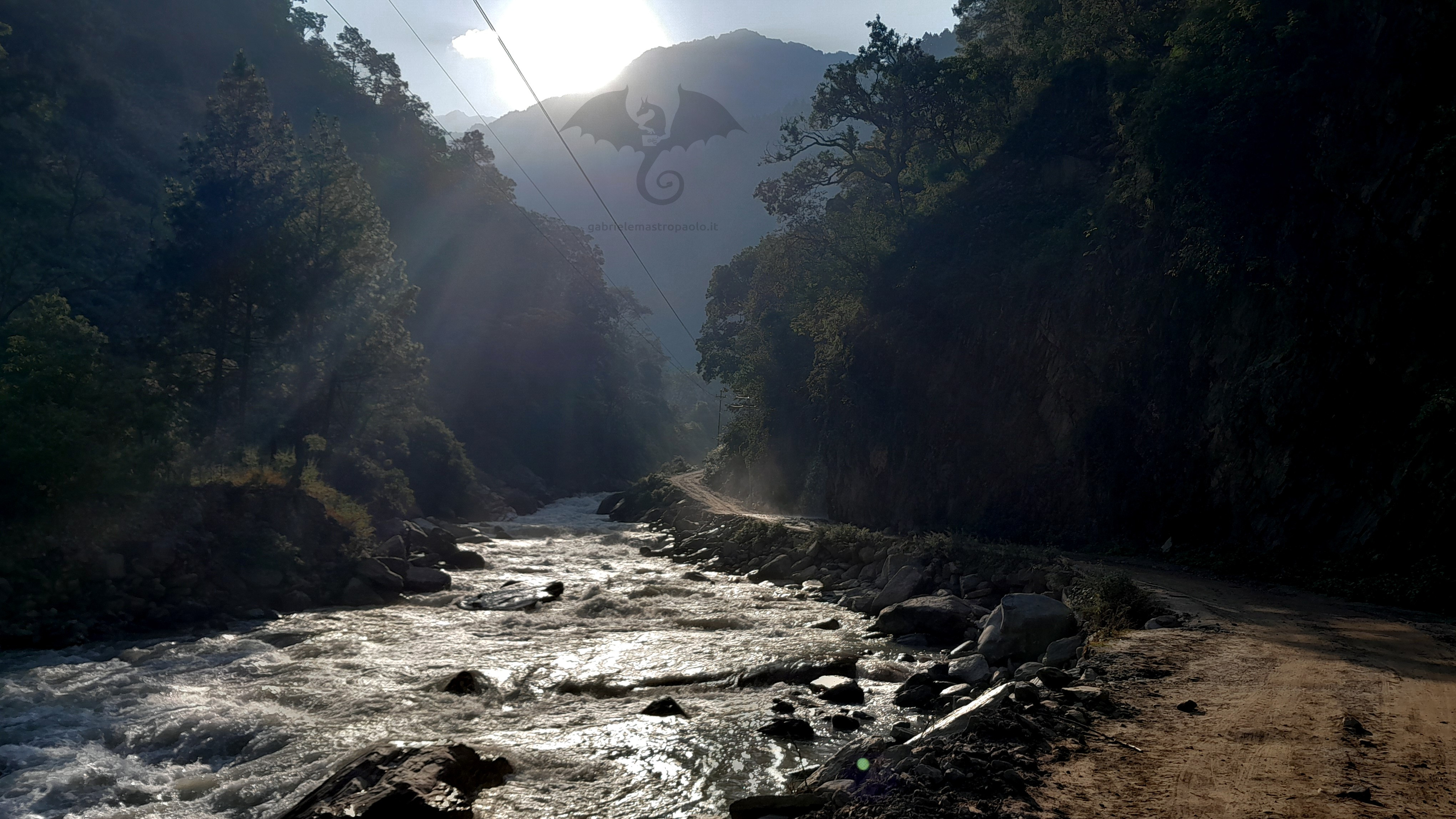 - I bet I know where I'll be staying: a guesthouse with lots of plants and flowers at the entrance. - I say this while the off-road vehicle slowly blocks off the pedestrians of Syabrubesi, who pay no attention to our vehicle. Padàm and the driver look at each other in amazement, nod vigorously.
- I've seen it in the videos, - I add, - I've studied -, and they laugh.
A boy takes my backpacks, signals me to follow him. He takes me to the first floor, puts the backpacks on the floor and gives me the key. It's cozy.
- The bathroom is in the room. There is hot water, - he tells me. Next to me is the kitchen. The smells of spices and rice awaken in me atavistic appetites.
The roar of the river fills the valley. The inhabitants of Syabrubesi no longer pay attention to it, just as in our villages we no longer pay attention to the chimes of the bell tower clock but we do pay attention when those chimes miss the mark.
The existence, the very survival of Syabrubesi is one with the roar of the Langtang, not only for the benefits that a river brings but the sound, the voice of the river is one with the physiology, with the air, with the biorhythms of Syabrubesi.
Compared to the mountain villages, Syabrubesi is already a town that enjoys privileges, there are roads, rickety but they are there, and there are connections with Kathmandu, there are school buses and there are heavy vehicles that guarantee the delivery of goods. In Syabrubesi there is also a construction site of considerable strategic importance, the construction of a dam and the drilling of the mountainside on the opposite bank to the town for the purpose of building a power plant.
Padàm takes my lunch order. We arrange to meet, then he leaves the room. With the door closed I sigh. It is not just relief. It is a state of ecstasy. It is realizing where I am, a place I have seen hundreds of times on YouTube. From there the real journey will begin. The absence of me begins to take shape. During my trek I will sigh often.
 The guesthouse is buzzing with festive air. In the hall - actually the dining room - there is always a coming and going of people leaving and people arriving, Namaste! Namaste!, the seats at the tables occupied by bulging backpacks; it is not just the gear - the technical equipment - that bulges, the backpacks overflow with expectation, amazement, wonder.
They serve me lunch, naturally a dalbhat. Padàm hands me cutlery, napkins and food. I watch him.
- Thank you, - I tell him - but you don't have to be so thoughtful, just do what I ask you to do. You are my guide, not my servant. - He thanks me and says nothing more, he will do this throughout the trip. There are other people in the room with me and there are other guides. The other guides do the same, they act like servants, like Padàm. Then I understand, and I understand that I don't want to understand. It's not just the hospitable nature of the Nepalese, serving guests is typical of guides. The fact is that they are not just guides, they are the real organizers of the trip, they are the ones who make the reservations, they are the ones who decide where you sleep, where you eat, above all to make you as comfortable as possible. In the hospitable mentality of the Nepalese, the concept of making your guest comfortable includes that of being his servant. Probably, in a cultural and unconscious substratum, there is also some form of reverence towards the European man, the European who brings money. This upsets me. I don't want a servant, I want a guide. But it's a lost cause: all guides do it, for them it's work, a guide who didn't do it would be disqualified, out of the loop.
At dinner, the festive atmosphere takes shape in a Sherpa dance accompanied by Padàm's harmonica, which pours into a traditional piece. At the large table, guests from Singapore celebrate their return from the trek in the Langtang Valley. They get drunk. The beer flows in pints. The words get longer. The atmosphere is light.
At my table I am alone.
- You're not having dinner? - I ask Padàm. - Sit with me. -
- I'm having dinner with the Nepalese, - he tells me. He segregates me, I conjecture. My guide segregates me. But I'm wrong. I'll understand it later, or maybe I won't understand it or maybe here too I don't intend to understand. This phenomenon will repeat itself every day, every lunch, every dinner. Padàm is ashamed to have dinner with me because he eats with his hands. He doesn't tell me this openly but his embarrassed refusals to my invitations to have lunch at my table let me understand it. I look at his fingers, very short nails.
- Why do you have such short nails? - I ask him.
- We Nepalese eat with our hands, if we had nails like yours the food would stay under the nails. You eat with cutlery. -
In the morning, breakfast for those leaving; at 4 the kitchen is already operational. Sleepy in my room, the aromas of spices and the hushed voices of our guests reach me. During the night, the exhibitionist sciatic friend comes to visit me, punctual for a year now. He makes an effort, he wants me to listen to him at all costs but I don't give in. I still manage to sleep six hours of intense sleep. A personal record for me, given the standards of the last twelve months. Also thanks to the bed, a thin layer of soft foam on a rigid wooden bench. On a rigid one, the road is uphill for the exhibitionist. The question of the sciatic nerve is one of those that I racked my brains over most during the preparation phase. In that year in his company, the nights were punctuated by his presence. It manifests itself only at night, during the day my movements are completely free. At night I can do two, three hours of continuous sleep, then it's all about doing somersaults on the bed, getting up, walking, doing postural exercises, but the nerve wakes up and there's no way. I fall asleep again only because I collapse, tired of trying to find a comfortable position. How will my sciatic friend behave during my stay in Nepal? In those twelve months I did not deprive myself of excursions, the nerve did not manifest itself even in the most critical conditions, but walking on rough paths and significant differences in altitude for a single day is something very different from tackling a journey of one hundred and forty kilometers for twelve continuous days with an average of a thousand meters of difference in altitude, not counting the rarefaction of oxygen. The highest point of my journey, Tserko Ri, is located at an altitude of four thousand nine hundred and eighty-five meters. At that altitude, the oxygen is fifty-five percent. Altitude sickness, the sensation of physical exhaustion due to the rarefaction of oxygen, can manifest itself already at an altitude of two thousand with headaches and nausea, in the worst cases with embolisms.
I consider myself tested for altitude three thousand four hundred, the summit of Etna, the Sicilian volcano, where I was a year ago without any problems but even there it was a one-day excursion, and above all I did not sleep at that altitude. In Nepal already on the second day I am at an altitude higher than two thousand meters, and the first two days of walking await me a little less than forty kilometers for a total of two thousand meters of altitude difference, with a ten-kilo zino on my shoulders, and the night's rest compromised by a heavy unknown. Will I make it? I have no idea. And after all, the question is in my plans like cabbages at a snack.
 October 9, 2024, day 3
The next day we start walking around 07:30. The sky is clear, the sun is still just a gleam. The surrounding peaks envelop us with their shadows. Padàm explains to me that it is always like this there: in the morning the sky is clear, in the afternoon thick clouds cover the peaks. From an altitude of three thousand meters and above, it snows at night.
In the first stretch of a few kilometers our path skirts the river along its course. It is a wide and muddy track, used by the construction site vehicles. The sun rises right from the bottom of the valley, the river is tinged with blue.
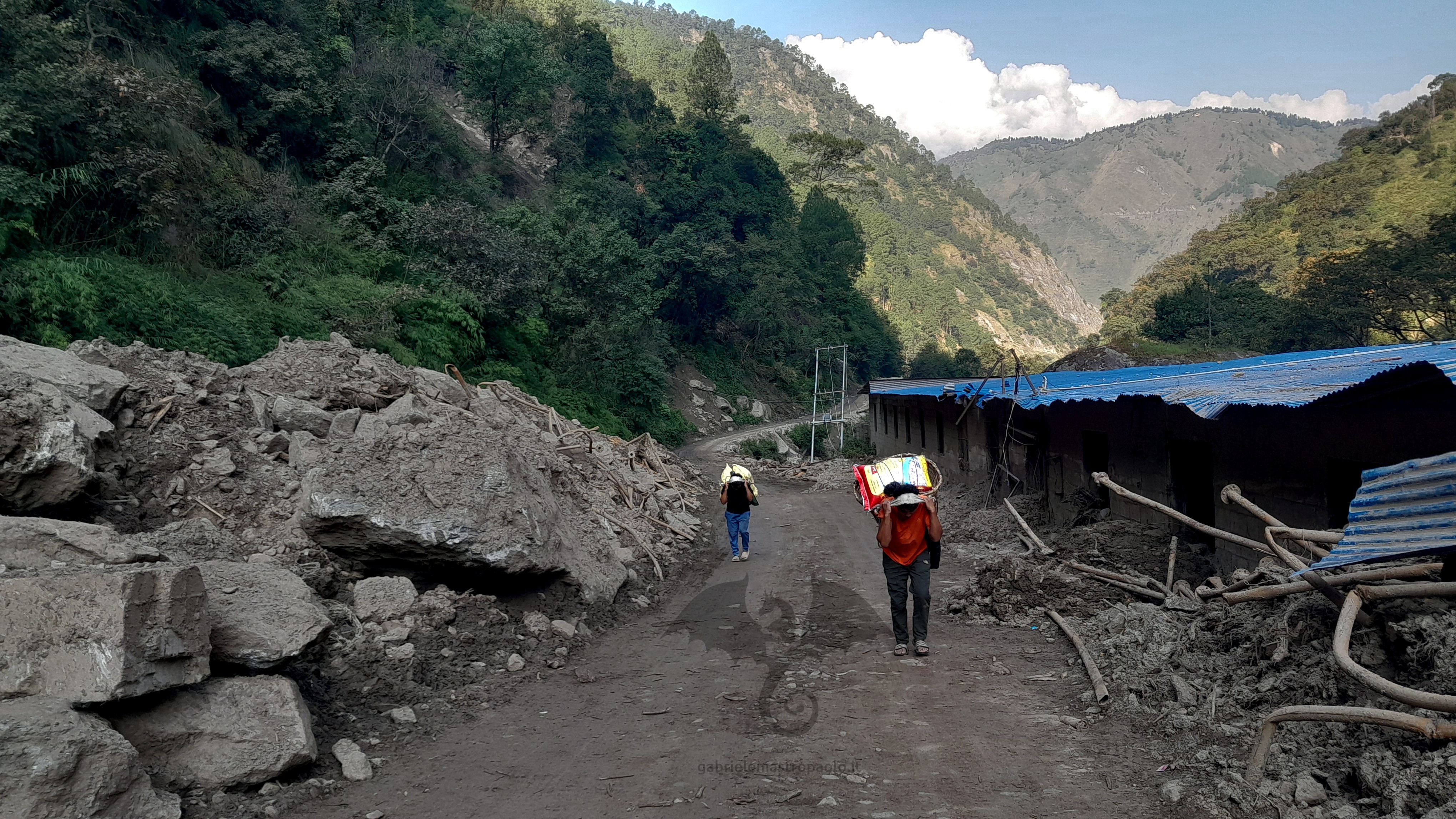
Waterfalls burst from the side of the mountain to fall on our path. Two figures rest at the edge of the river. They are two Sherpas, two boys in their twenties. They are fiddling with their cell phones. A Bluetooth speaker plays techno music with a Nepalese twist. Next to the Sherpas, two bundles. They must weigh at least fifty kilos each. Refreshed, the boys load themselves with aftershocks. The weight bends them so much that the only thing they can see is the ground and their shoes. Shoes. Not like mine, technical boots suitable for long and rugged walks. The two Sherpas are wearing plastic beach slippers. They will wear them for the entire duration of the walk, a long walk made of rocks, mud, almost vertical climbs, with differences in altitude of up to a thousand meters. Here in the Himnalaya, goods circulate like this, with Sherpas or donkeys. Padàm explains to me that he has done that job for five years. A Sherpa is paid by weight, the more he carries, the more he earns. He can carry up to seventy kilos.
- And how much does he earn? - I ask.
- Two hundred and fifty, three hundred Nepalese rupees per trip, - Padàm tells me, and laughs. He laughs a bitter laugh. At the current exchange rate, one hundred and forty-two Nepalese rupees are worth one euro. The Sherpas carry up to seventy kilos on their shoulders for tens of kilometers a day and a thousand meters of altitude difference with a net earnings of two euros. Two euros.
We reach the nascent structure of the dam, a concrete pour on the riverbed. A little further on, the mud track gives way to the actual path. Finally, our shoes are on native soil. Finally, we enter the forest. Finally, we climb.
The roar of the river escorts us. The smells of the vegetation inebriate our sense of smell and imagination. The images prompted by those smells are not the ones my eyes see, they are not the ones I have seen hundreds of times in videos on YouTube. They are other images, of unknown origin, whose reverberations are equally unknown. They are something new. That sense of the unknown, that not knowing what and that not knowing how excite me. It is the absence of me that pulsates. Those olfactory images evoke intangible concepts, concepts that were there before me and in their long and distant course now find an outlet in me, like the powerful currents of the Langtang that flow a few meters away.
Twelve kilometers of trail and nine hundred meters of altitude difference await us. A steep climb but nothing so new.
The destination is Lama Hotel.
We reach Bamboo. It is a village with a few buildings but compared to the villages with single houses that I will find along the way, this is already a small town. It is perched on a rocky ridge that immediately overlooks not the river but the force of the river. The Langtang is its force. Except for a few, short stretches, the Langtang is not a swimmable river. The current would break the bones of a rhinoceros. Lloyd Wright's Fallingwater, amateur stuff.
We take a break. We order lunch, my first lunch in the valley. It will all be a mix of first times, first loves.
The village is full of hikers, hikers of all ages. Technical T-shirts soaked in sweat, tanned arms, bare feet, phosphorescent colors of backpacks resting on dry stone walls, soft words in a babel-like English. And of course the smells of fried vegetables and boiled rice.
Padàm takes my order. After a few minutes he hands me my dalbhat with his usual servant bows. I am annoyed but I have already pointed it out to him. The word sir is his favorite interjection. What do you want-sir, good morning-sir, good night-sir, look here-sir, look there-sir, we will go a very steep stretch-sir, we will go a flat stretch-sir. Each interjection is accompanied by bows. It is stronger than him. For him it is a habit.
- Drinks-sir? -
- Do they have beer, - I tell him.
- Sure-sir, do you prefer Tuborg or local beer-sir? -
- Let's try the local. - I answer.
The local beer will be good. And the dalbhat too. Ten minutes of post-lunch relaxation.
- May we go? - I ask him.
- Sure-sir! -
Backpacks on, we continue walking.
The path gets steeper. The roar of the Langtang fills all the gaps. The path is a coming and going of people, distracted and distracting people, mostly chatty and noisy people, inconceivable for a place like that. They take selfies, they shout, they show off to the women, the women show off to the boys, they pose. Bluetooth speakers blare techno music. I would slap everyone. But these are adventurers without a future: they will stop at the lowest altitudes, they will rest on the edge of the trail with their running sneakers and their tongues hanging out and the energy bars that they will not know what to do with, except throw the papers on the ground. The trails are dirtier than I imagined. My guide confirms that they are the locals. The most daring are the most motivated, the most sensitive to the cause. Group hikers or solitary hikers, we are the most silent, the most collected on our shoes, on our thoughts, swollen with our amazement. Our amazement gallops against the current on the bed of the Langtang, overcomes its impetus and heads straight for Kijangjin Gompa, the last village in the valley.
In front of me are two boys, probably Indians, with a rather fluent way of speaking. Immediately in front of them is a hero, a monument to diligence, a champion of temperance: a solitary hiker. The two chatter and breathe down his neck. They probably don't realize it. I wonder how he doesn't realize it. I respect him. He hits the ground with his sticks, his head down to calibrate his feet and their movements. The path is full of traps for ankles and malleoli, one false step and it's over. Sometimes the sticks hit harder, perhaps to better affect the ground. Or perhaps not. I begin to suppose that that relentless hitting is actually the echo of a discomfort. It is the solitary hiker himself who resolves my doubt: he stops, turns around, invites the two chatterers to continue on. He doesn't utter another word, but it's easy to read between the lines a heartfelt "fuck you." The path turns downwards. On the left, the roofs of some buildings: Lama Hotel.
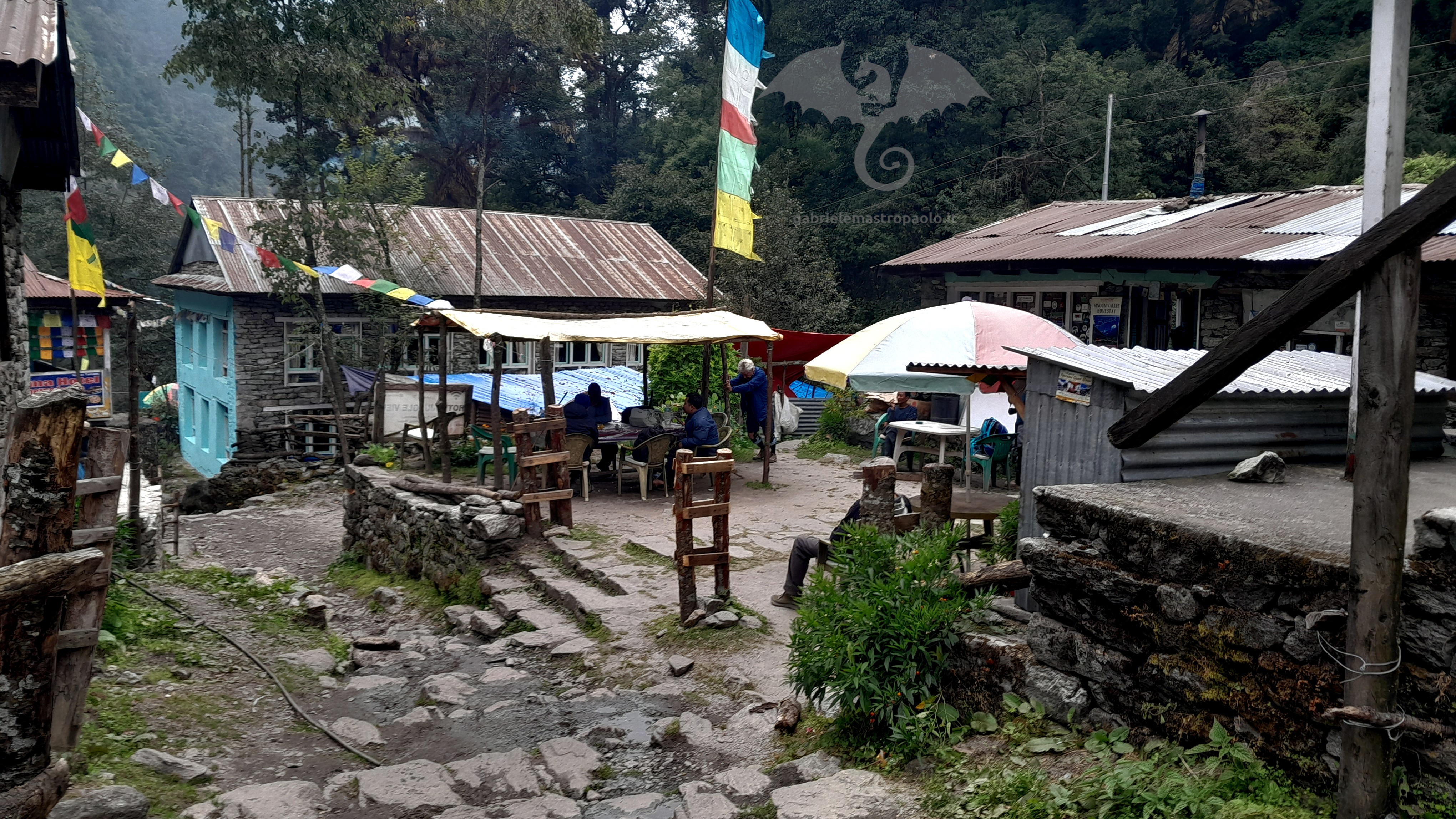 Despite the name, it is not a hotel but a village, a collection of buildings used as guesthouses each with its own repertoire of tired hikers and hikers ready to go again, grimaces of pain and happy faces, backpacks on shoulders and backpacks on the dry stone walls.
- There is a problem-sir. -
Padàm looks at me with a contrite face in a grimace.
- Tell me, - I say to him.
- We don't have rooms. -
- What do you mean? - I say to him.
- The guy where I booked told me on the phone that there are groups and the rooms are for groups. Business-sir. -
- And the reservation, then? - I say to him, - If you have booked he must give you the rooms. -
- Business-sir, - he repeats.
A guy approaches him. They start speaking in Nepali. The guy looks at me. In turn I look at him. I approach him and say:
- Please, give us a room. -
He watches me in silence, then turns to Padàm in Nepali, gesturing with his face toward the rooms. Padàm says to me:
- We have the rooms-sir. -
The guy says to me:
- Hello friend. Padàm's friends are my friends.- And he hands me a key with a padlock.
- Number 9 is your room, - he says to me. - Welcome, sir. -
I offer him a hand with a heartfelt thank you. I head with Padàm toward the room. After opening the door, I put my backpack on the floor. Padàm does the same with my second backpack, which he is responsible for.
- That man is kind. He got us out of a real pickle. -
Padàm watches me.
- Where is the guesthouse where you initially booked and that gave us the boot? I'm curious to see the face of the asshole who refused us the rooms. -
- It's this-sir. I had booked here. -
- Ah, - I say.
Padàm doesn't give me the chance to say anything else, he walks off towards the dining room without saying one single word.
Lama Hotel is a village nestled between rock walls whose peaks cannot be seen. It is close to the river. Here, as in Syabrubesi, the roar of the Langtang is one with the biorhythm of the people who live in the village.
I get familiar with the room. From the backpacks I take out the necessary for changes and the minimum for toiletries. Before leaving, I had obtained a series of zip-lock bags creating compartments inside the backpacks dedicated to t-shirts, socks, etc. Organization of contents. When you go on a two-week trip and every day you carry all your stuff with you, you have to organize your stuff well, if you don't, the risk is spending half your time arranging and rearranging the contents of the backpacks. Before entering the room I noticed a very rickety wooden cabin with two equally rickety entrances located just beyond the rooms. On one it says toilet in English, on the other hot shower. Inside, it's pitch black. As I unpack my stuff, I've already decided that the shower can wait this time. From my backpack I take out a pack of wet wipes.
The dining room is also a dormitory. There are signs of the night gone by, unmade duvets, pillows, blankets on the benches. I like that sense of promiscuity. I like that sense of precariousness. It is part of the journey, it is part of that sharing of spaces that cannot be peremptory, cannot be regimented. The feeling of being a guest, of finding yourself passing through a temporary whole. I am looking for a temporary center of gravity, to paraphrase Battiato. Permanence does not belong to me. The idea of a center does not belong to me. It does not belong to the world, it does not belong to the universe. A common mistake is to consider the big bang as the center from which the universe originated. The universe has no center, or rather it does not have a single center. The universe expands constantly from a myriad of centers. The Hubble constant measures this movement of expansion of the universe. The Hubble constant actually tells us how variable the universe is. Any point in the universe is its center. We are not things, we are phenomena of things. We are not made to stand still, we are made to move. We do not see things, but things that mean other things. Another paraphrase, the good Italo Calvino.
The dining room of my guesthouse excites me. I had seen those spaces, that wood stove, those glimpses of the kitchen hundreds of times on YouTube, and now I was there. The Sherpas sit around the stove. They wear wool hats and down jackets. Flip-flops on their feet, they stretch them toward the flame of the stove. They tell stories, they joke, they laugh, the few Nepalese women present make bets.
I sit on the bench, I take a menu. The trusty Padàm asks what I order. Veg choumin, Nepalese spaghetti with vegetables. Ten minutes later, Padàm returns with a plate full of veg choumin. The look and smell are inviting. My stomach rejoices. The taste is excellent. I ask for seconds.
A man and a woman to my right are watching me.
- So hungry, - I tell them.
They laugh. The man has his menu in his hand, he examines it carefully, undecided.
- You gave me an idea, - he says to me in an English with a strong French accent. - And then, what better review, - he says to me.
- I understand, I was your guinea pig, - I say.
They laugh again.
With the two Frenchmen the chatter starts. It turns out that I'm Sicilian,
- Oh, I've been to Sicily, beautiful! - he says.
- Where, in particular? - I ask him.
- Oh, a nice long tour, Aeolian Islands, Trapani, the volcano. -
- Etna. -
- Yes, right, Etna. Wonderful. I want to go back to Sicily. And you, do you speak French? Have you ever been to France? - - No, maybe, - I answer.
- Eeeeh, but then...! - the man and the woman say in chorus. We laugh.
- But I want to go to Corsica, - I say, - I want to do the Grand Randonnè 20. -
- It's the first time I've heard it said in full. Usually I only hear GR20. -
- I have a thing for names, - I say. In the meantime, a tall, thin man offers them plates. Their sherpa. Their servant in pectore.
The woman speaks.
- And where are you going, up or down? -
- I'm going up, - I say. - Tomorrow, direction Langtang Village. And you? -
- We're going down, for us it's almost over. -
- And what are you taking back to France from this trip? - I ask them. - What's left inside you? -
- Without a doubt Tserko Ri, - the woman replies. - You will go to Tserko Ri? -
- I will go to Tserko Ri and Kjiangjin Ri, - I reply.
- Both? - they blurt out.
- Yes, - I say - I will arrive at Kijangjin Gompa for lunch, I will have plenty of time to go up and Kjianjin Ri, the next day I will go up to Tserko Ri.-
- That is crazy - she says. - Usually you do one or the other. Also consider that to go up to Tserko Ri you will have to leave at night, we left at 4. You will not have time to rest. -
- I do not know if this will be a unique opportunity - I say. - It certainly is at the moment. I do not want to waste it. Who knows if and when I will return. It is worth trying Kjiangjin Ri and Tserko Ri. If I succeed, good. If not, never mind. I do not like regrets. -
The man and woman begin to eat their dinner. In the meantime, I have finished mine. The room has started dancing to the techno music. The guy, the boss, comes out of the kitchen in obvious alcoholic euphoria. He stamps his feet on the wooden floorboards. The music follows. He sings. I mean, he sings: he screams. I detect hints of hysteria but maybe I'm wrong. The Sherpas around the wood stove clap their hands in time.
But yes, I am wrong.
The night passes punctuated by visits from the sciatic nerve. Excruciating pains. Then, as usual, I collapse exhausted.
The faint light of dawn emerges from the thin glass of the windows of my room. With barely six hours of equally scarce sleep under my belt, I decide that is enough. I dedicate myself to my toilette. I put on my shoes. I go out. It is barely six o'clock, it is already a swarm of hikers, of sneezes, of coughs. I have an urgent need but I'll pass on using the toilet this time, I'll shit in the branches.
Breakfast with Nepalese bread, honey, omelette and ginger tea.
At 7 we're on our way.
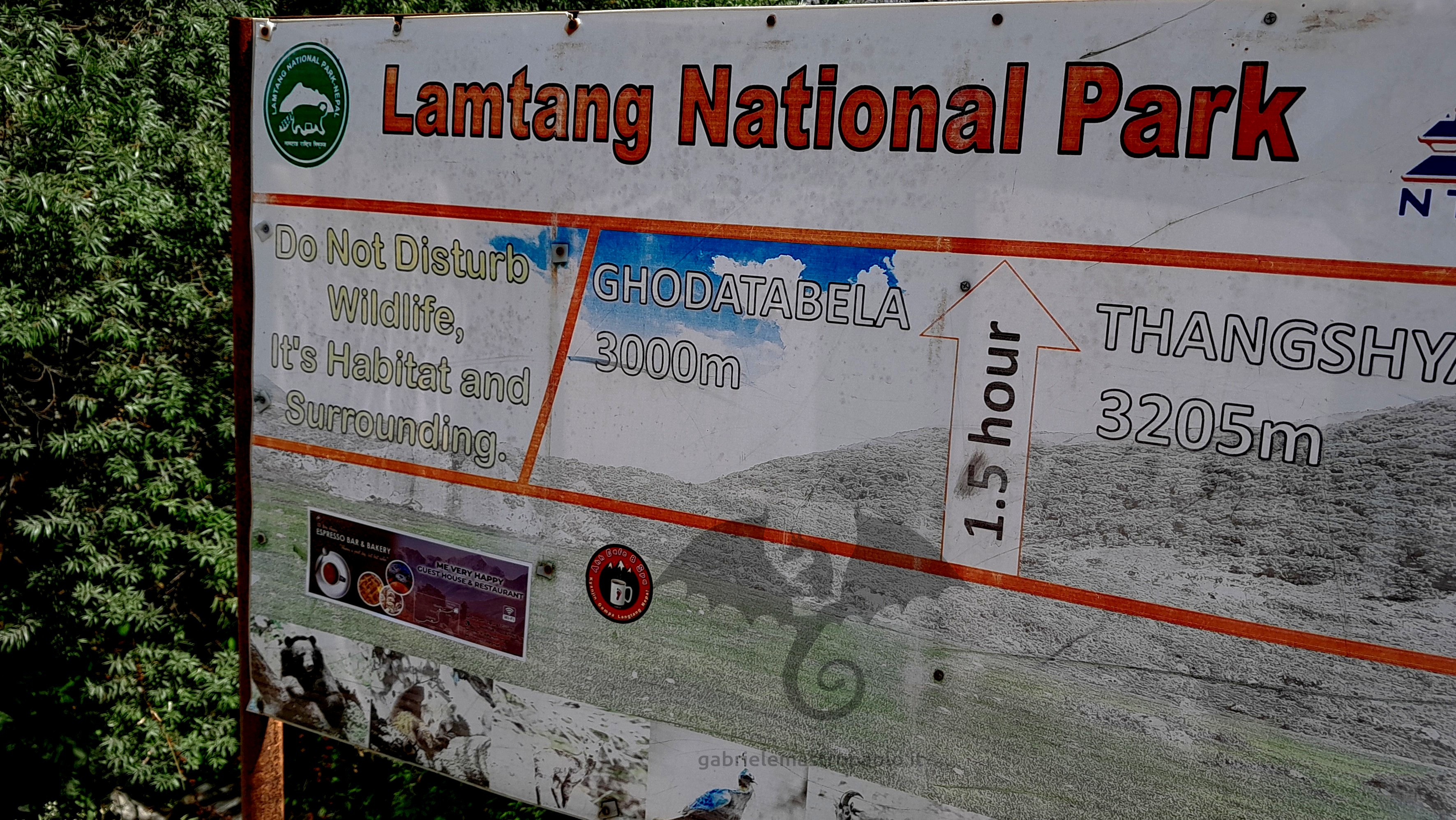 October 20, 2024, day 4
Our stop is Langtang Village, fifteen kilometers of route and eleven hundred meters of altitude difference. In reality what we will find will be a reconstruction. In 2015 an earthquake caused a landslide that devastated Langtang Valley and razed the entire village. There were about a hundred deaths, hikers and locals. The bodies were never found. The village was then rebuilt further on with state funds.
Leaving Lama Hotel without regrets, we dive back into the subtropical forest. Steep and unstable stone steps, slow pace, hikers coming, hikers going, Sherpas, the ringing of sticks on the rocks, the usual chatterers with techno playing but their swarm will thin out at higher altitudes, like insects. Above all, the roar of the Langtang, a faithful accomplice. We reach Riverside, a village near the river in a relatively flat area. We take a break for a cup of ginger tea. We continue on our way. Gaining altitude, the forest fades into living rock. Another two hours of walking and we reach Thiangshiap, where we take a lunch break. Enlivened by his usual bows, Padàm takes the order: fried rice with vegetables.
- Drinks, sir? -
- Tuborg, - I tell him.
The sky is clear, between a few gusts of wind, the branches of the trees surrounding the village rustle with a litany of a holiday vigil. The food is excellent. The sun's rays caress our faces. We set off again.
Without the canopy of conifers, the view is wider and deeper. At the bottom of the valley, the first real snow-capped peaks of the Himalayas can be glimpsed. Himal is a toponym common throughout the chain, it is an adjective and means 'snowy', Himalaya means 'houses of snow'.
The path is escorted by dry stone walls on whose stones words are engraved but no one knows the meaning of those words except the lamas. Esotericism of the bonzes. Those meaningless signs accentuate the fascination of the hidden side of everything that surrounds me, what I perceive without perceiving it, what I know without knowing it, what I see without seeing it.
There is an area with a small white building. At the top there are two crossed knives like scimitars. It is a memorial. It remembers the victims of the soldiers who guarded the route during the 2015 earthquake.
Everywhere there are mountains with inscrutable peaks. The rock is pierced by waterfalls that pour their jets from very high altitudes, the roar of the water reaches me from afar.
A little further on, the roofs of buildings painted blue overlooked by snow-capped peaks.
Langtang Village.
Langtang Village is an enchanting place. Each building is surrounded by flowerbeds with extraordinarily colorful flowers. At three thousand five hundred meters above sea level I did not expect such greedy flowers. Between one building and another the entrances are distributed along stone paths set like cobblestones. My room is comfortable, has its own bathroom, hot water. I treat myself to a long shower. For dinner I order momos, steamed vegetable ravioli. The dish consists of ten generous portions. To drink, beer. I eat my fill. Padàm and I stage a little showdown that amuses the other guests in the dining room, he cannot pronounce the 'r' in macaroni, a dish on the house menu, I teach him sharpening exercises.
At night I manage to get a restful sleep, far from the noise of the sciatic exhibitionist.
The next morning, breakfast at 7, chapati with honey and a cup of ginger tea. Chapati is our piadina.
Departure at 8am for Kjangjin Gompa.
 October 21, 2024, day 5
Kjangjin Gompa is the last outpost of the Langtang Valley, it is the village with the highest altitude, three thousand nine hundred meters.
Seven kilometers of path and a difference in altitude of three hundred and eighty meters await us, a walk.
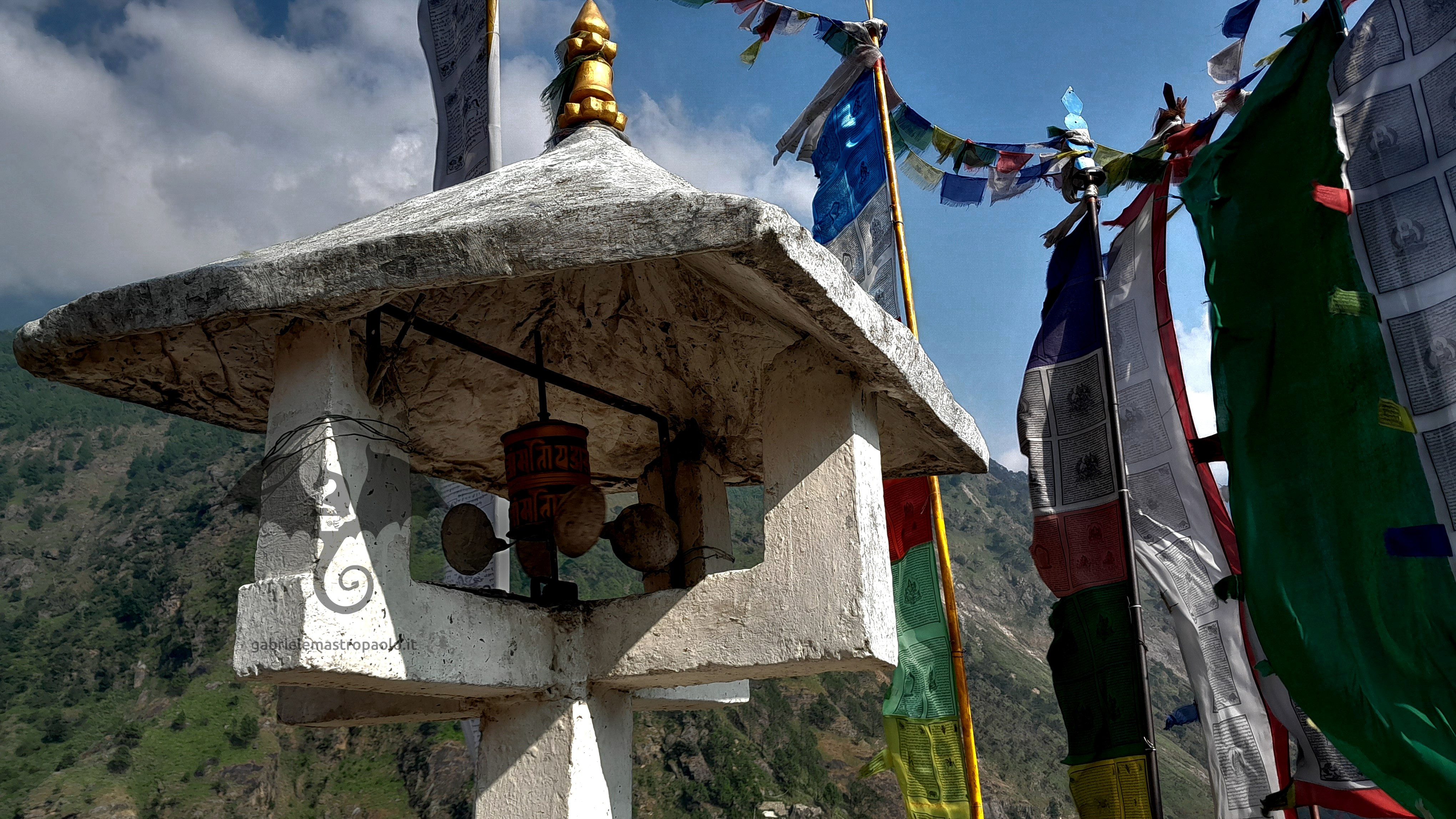
Just before the village there is a Hindu monastery. There is a series of prayer wheels set in metal housings. The prayer wheel is actually a cylinder on its surface is printed in relief the Tibetan mantra 'Om mani padme hum' in Sanskrit. Normally a prayer wheel is operated by hand, here they are operated automatically by the current of a stream thanks to fixed paddles at the bottom of each wheel, the same principle as a water mill. There is a stupa with a very colorful entrance. Inside, a large prayer wheel, operated manually with a handle. At each complete turn, a rod at the top strikes a bell.
Places of prayer, ALL places of prayer of any religion, do not arouse my sympathy but this one is an exception: the environment is very colorful, the walls are colored blue, the wheel is red. It is a combination that works, it induces a state of peace and well-being. The wind does its part, the soft sound of the typical colored pennants flapping reminds us in their own way that existence consists of discrete perceptions.
The stop at Kjangjin Gompa includes two days, one day of acclimatization and one of hiking. The village is the access route to two peaks that tower over it: Kjangjin Ri, with a lower viewpoint, four thousand four hundred meters, and an upper viewpoint, four thousand seven hundred meters, and Tserko Ri, four thousand nine hundred eighty-five meters. Usually hikers choose one or the other. I choose both. Padàm tells me that Kjangjin Ri is the favorite destination for foreigners, while Tserko Ri is more populated by locals. By 'foreigners' Padàm means 'Westerners', while among the locals he includes hikers from Bhutan, India, and Pakistan.
There is time for a meal. I treat myself to a soup of choumin and vegetables. Tsering, our host, who is also the cook, asks me if I prefer to have lunch outside or indoors. The sky is clear, a light breeze blows, the sun grants a pleasant warmth. I will have lunch outside. All around me, the snow-capped peaks of the Himalayas.
Just beyond my table there is a dry stone wall, beyond the wall there is another guesthouse with its repertoire of hikers coming, hikers going, locals going to the garden and picking vegetables, and there is a girl. She is washing dishes at a water spout. She looks at me and smiles, a smile full of joy for life. I wave, 'ciao' I say to her in Italian. She responds eagerly, she waves her mouth by dragging a finger across her upper lip and then points her finger at me. My moustache. I touch my moustache. 'Nice!', says the girl with her smile. She likes my moustache. Then she says something else that I don't understand, at that moment a gust of wind blows that covers her words. I ask her to repeat, she repeats but the wind blows. La dolce vita. I am living a scene from the film, the final scene. Marcello is on the seashore, the wind is blowing hard, a little further on there is a girl, a waitress he met at a restaurant, she says something to him but he doesn't understand, she repeats but he doesn't understand and finally shrugs. And with bitter resignation he makes a gesture as if to say 'goodbye forever'.
After lunch, I ask Tsering if he has a map.
- Sure, sir - he says to me. He takes the map and hands it to me.
- No, - I tell him while brandishing my cell phone - I want to make a clip of you telling us the names of the mountains that surround us. -
- Sure, sir. -
Let's make the clip. Time is running out.
We're going up.
It is a very steep climb. We proceed at a slow pace. It is my first, authentic test of endurance, that new thing that scares me a little. We are at an altitude of four thousand, up to that point no nausea, no headache, no feeling of asphyxiation typical of altitude sickness. I should already be acclimatized but you never know, it is all new to me. One step after another. Every fifty steps or so, a stop. Time is running out but I do not intend to risk it, slowness is power. I take advantage of the stops to look around. As we gradually gain altitude, snow-capped peaks emerge after other snow-capped peaks, behind me the village is the only detail that makes it smaller, everything else is amplified by the majesty. I realize that I am left speechless: to inhale more air, in amazement.
Except for the steepness, the trail has no other critical aspects, four kilometers long for five hundred meters of altitude difference, close to a vertical. The ground is scattered with rocks of varying sizes, the risk of a fall is high. I help myself with the trekking pole. The wind rises, from the bottom of the valley wisps of condensation rise that will become thick clouds.
We reach the lower peak, an altitude of four thousand four hundred. It was hard but not very hard, no nausea, no headache, nothing other than normal physical fatigue in the legs only, I inhale gulps of air in full lungs. The clouds envelop us, moments of total absence of visibility alternate with clear clearings.
I absent myself. I abandon that sack of flesh and bones they call Gabriel. I ignore myself and I ignore everything else. Thoughts vanish, my mind empties. I abstain from myself, I abstain from thinking, from using adjectives, from seeking metaphors, from describing what I see, it would be an exercise in corruption. The exercise of being becomes worn out.
Colored pennants dot the summit, there is a plaque that reports the name and the altitude. They flutter in the wind. From the bottom of the valley the wind rises, its voice rises. I sit on a rock.
In the mountains, the descents are more treacherous than the climbs. The one from the top of Kjangjin Ri is no exception. Every other step slips on the gravel. Padàm descends quickly but Padàm carries half my weight, compared to me he is a small being. We stop on a rock whose shape vaguely resembles that of an armchair. Our path winds corrupted by rocks, in front of us another path proceeds quickly halfway up the hill. It is a less steep path, less stony, with a substratum of bare, low, red vegetation.
- Let's take that path, - I say - it seems better, there is grass, it will lead to Kjangjin Gompa anyway. - When the critical points of a path add up, when in doubt go on the grass, the ground is more stable and the step is firmer. Padàm approves my proposal. He proceeds respecting the hairpin bends, I cut and descend galloping. In a shorter time than expected we are at the village.
- The next time I bring guests here, - says Padàm - I will descend from this path. -
Beyond the usual low wall there is the girl, she greets us, I answer 'ciao' and she says 'ciao' smiling.
Hot shower, then dining room.
Tsering, our host, is about thirty years old. His hands are wet from water, he is washing vegetables. All around the walls of the room is the cupboard. In the middle of the long side of the room, the cupboard stops to make room for a shrine with a photo of the Dalai Lama. There are some lit candles. Padàm approaches the shrine and says a prayer. Padàm is not Buddhist, he is Hindu. I have seen a similar phenomenon in Kathmandu, even though Buddhism is a heresy of Hinduism, Hindus do not formalize themselves to pray in front of a Buddhist stupa and Buddhists do not formalize themselves to pray in Hindu temples. Christianity is also a heresy of Judaism and yet Christians and Jews hate each other to death.
Next to the shrine are two photographic portraits, a man and a woman.
- My parents - explains Tsering. - They died in the 2015 earthquake. We lived in Langtang Village. -
For dinner I order roasted potatoes and a plate of spaghetti with vegetables.
Tsering asks me where I'm from.
- From Italy, - I say.
- Oh, Italy, - Tsering says, and points to a display case in the cupboard where packets of pasta are kept.
- Pasta or spaghetti? - Tsering asks me.
- Spaghetti and pasta are the same thing, spaghetti is pasta, - I explain. - Spaghetti is a type of pasta. -
- Really?? - Tsering blurts out in surprise.
I take the menu, in the menu there is a section dedicated to Italian dishes, there are also 'macaroni', it is written exactly like that. I point to 'macaroni'.
- Even 'macaroni' are pasta. The shape changes, the shape is important. If you like tomato sauce you use 'macaroni', so the sauce goes inside the 'macaroni'. If you like fried vegetables instead you make spaghetti, when you are about to finish, the spaghetti helps you collect what's left of the vegetables. When we collect what's left, in Italy we say that 'we 'scarpone'. -
My explanation amuses Tsering a lot.
We joke a bit in front of a cup of ginger tea and the fire in the stove in the center of the room. Then I thank you and wish you goodnight.
It's just 8:00 p.m. When you walk you go to bed early, especially if you have sciatic exhibitionists who come to visit you in the middle of the night.
And then the next day Tserko Ri awaits us. With Padàm we agree on the time for breakfast: 4:00. At five we leave.
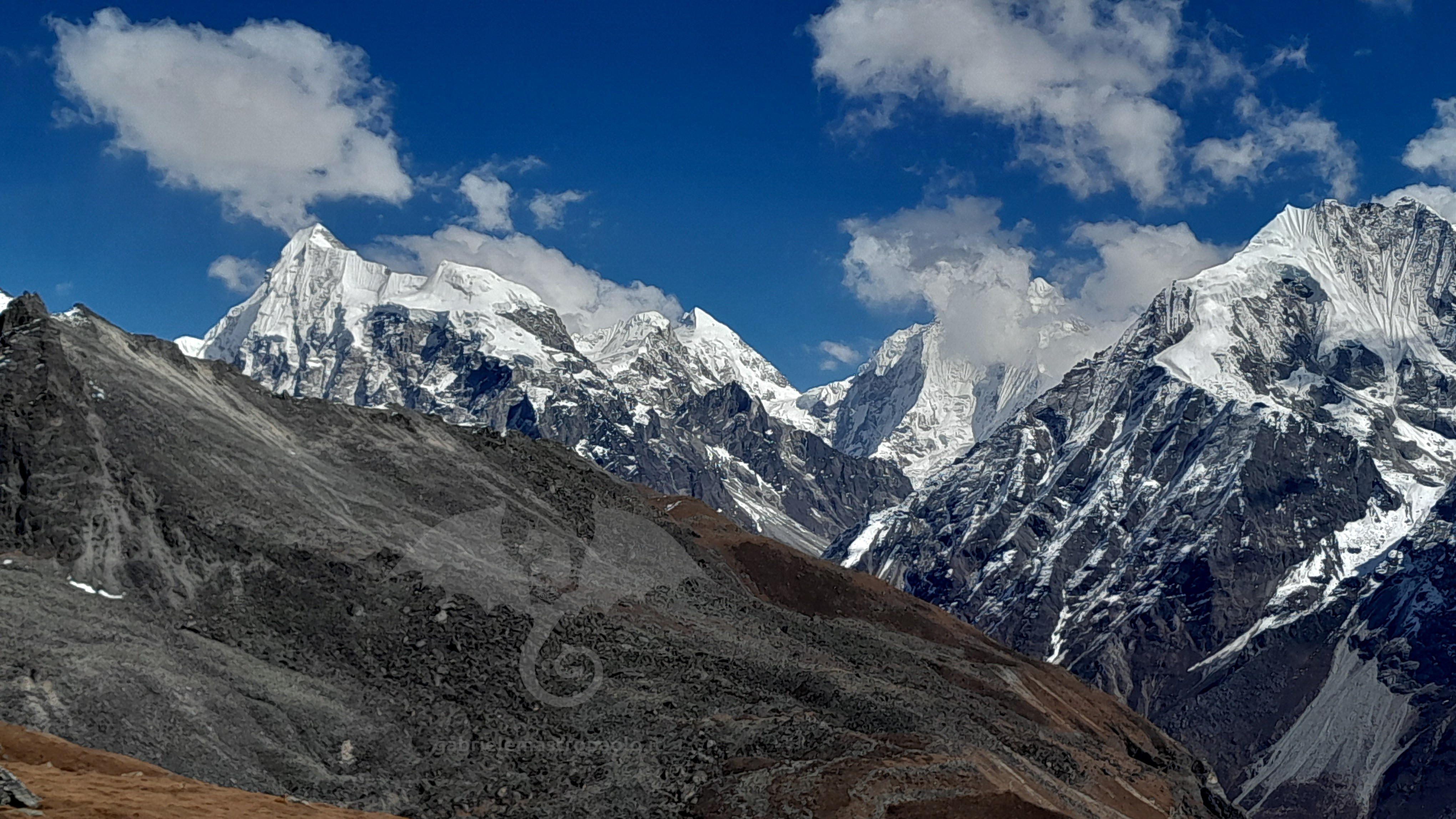 October 22, 2024, day 6
The reason for the nightly rising is twofold: the length of the route and the difference in altitude are almost double those for Kjangjin Ri, eighteen kilometers there and back for eleven hundred meters. And then there is always the constant overcast sky. Being higher, Tserko Ri is more exposed.
We set off in the dark. I have a headlamp but I don't need it. The sky is clear, dotted with a myriad of stars, never seen so many stars like this; the moonlight sufficiently illuminates the ground, the stones, the stream beyond Kjangjin Gompa. And the still dark silhouettes of the mountains with the sharp contrast of the white of the peaks. The slopes of Tserko Ri are streaked with a row of moving lights, they are the hikers who preceded us, less in love with the moonlight than we are. We cross a stream. In Sicily that watercourse would have been classified as a river. We begin to climb. Groups of hikers are already lining the first bends. They are gasping. Deep gulps of air to make up for the oxygen. At the top of Tserko Ri it is at fifty-five percent. As for me, the fatigue is still far away, the training at Kjangjin Ri is useful to me but I proceed extremely slowly, we have all the time, and above all I intend to enjoy it all, moment by moment, meter by meter, breath by breath. During the climb the number of the fearless will gradually fade.
With the other hikers we encourage each other, we tell each other - ourselves more than others - that it's not that far, we advise each other to go slowly, to rest often, to drink lots of water.
A voice behind me asks permission. I let him pass. He's a tall, bearded man, he says something to two others, he's Slavic. He walks quickly, planting his poles on the rocks and he's wearing only a t-shirt with a down jacket. It's about five below zero. Reckless, I guess. I lose him, he's going fast. After an hour I meet him again but he comes down. He looks at me.
- Too cold, I can't do it, - he says as if to apologize - all this is enough for me - he brandishes a pole and points to the view.
The sun is not yet high but its glare is already touching the top of Langtang Lirung, the highest peak in the entire valley, seven thousand two hundred meters, coloring it pink. The glow hits the valley, slowly the night shroud slips away until it disappears.
I intercept a group of Nepalese. One of them is without a backpack, trusting in the water reserve of his body. Too trusting. We will find him later begging for a sip of water.
The climb is hard. Each step weighs a boulder. My backpack is light, it contains three liters of water, four hard-boiled eggs, a few chocolate bars and crampons for walking on the ice. The top of Tserko Ri is covered in ice. It is a peak constantly beaten by the wind, which increases the sensation of cold and sweeps away the ice on one side of the mountain.
Halfway up the climb I begin to have some doubts, maybe I won't make it. From there I can see the silhouettes that stand out in the sky of those who are close to the summit. I see them climbing, dragging themselves up the last stretch, even steeper, rocky and covered in ice.
The sun now dominates the valley, which lies in the presence of the empire of its light. It's only eleven o'clock, we've been walking for a good six hours and we're not at the top yet. I slow down my pace even more. I need it. My steps are heavy, the ground is strewn with traps, with every step a stone under my shoes, with every stone a loss of balance, twirling with a wand, deep into the ground, calibrating the weight of the backpack, which is as if during the climb someone had fun filling it with clay. Stops every thirty steps, bites of chocolate bars, sips of water.
But I tolerate all of this, no headaches, no nausea. My level of fatigue is limited to my legs, my breathing is holding, in the upper part of my body everything is under control. I have no excuses, I have to continue.
A man with a long white beard, few teeth, dreadlocks, shorts, three layers of jackets on his shoulders. We had met further down during a break, then he had gone ahead. He was gasping. He was mumbling something to himself, probably swearing. We meet again as he goes down, he raises his mirrored sunglasses.
- It's wonderful! - she tells me - it can't be described! Things worth living for! - Her eyes are full of joy.
There's a woman, she's also obviously exhausted, we look at each other, when she's gathered enough breath she tells me:
- There's no going back! There's no going back! - We laugh, then she fixes her steps and continues. A little further on two men will put their hands under her arms and support her.
After an hour we reach the steepest side of Tserko Ri. The path disappears, in front of us only imposing blocks of rock whitened by ice. We proceed on all fours. I stop on a rock, I take my crampons out of my backpack. The first steps are a disaster, I've never worn crampons in my life, I bought them just for my trip to the Langtang valley. Padàm laughs. I tell him to go to hell, in Italian and in English, I show him the middle finger. Padàm laughs louder. A few cold falls, I get up in a bounce, put on my backpack and off we go. The summit is right in front of me but there must be someone behind it who is moving it, there is no other explanation.
We reach the summit.
- Welcome to Tserko Ri-sir! - Padàm tells me, offering me his hand and a bow.
I offer him my hand, then I turn away, I look around.
In Europe the highest summit is Mont Blanc, four thousand eight hundred and five meters, in Italy the highest refuge is Capanna Margherita, Punta Gniffetti, Monte Rosa, four thousand five hundred and fifty-six meters. On Tserko Ri I find myself at four thousand nine hundred and eighty-five meters.
My breathing is regular. I sit. I absent myself.
On the opposite side of the valley, in front of us, the summit of Ganchenpo stands supreme, six thousand three hundred meters, with an imposing vertical wall on whose sides the profile fades violently downwards, with the crests of its glacier drawing straight lines. It vaguely evokes the shape of a ghost, the classic ghost with a sheet, a ghost that watches you and that waits for nothing more than to welcome you with open arms, with the crests of the glacier that fall straight down to act as folds in the sheet.
Further north, a series of peaks plunges towards a plateau covered in snow and ice. Gusts of wind raise enormous piles of snow that immediately become impenetrable blankets. Among those peaks, the Ganja La, a little further on, the Ganja La Pass. During the months before leaving, when I was studying, when I spent hours and hours on maps, videos, itineraries, on my doubts, on my few and shaky certainties, when I was absorbing everything, eager for everything related to those places and those peaks, I had considered the possibility of doing the Ganja La Pass. The Ganja La Pass is classified as one of the most challenging passes in the whole of Nepal. To get there, it would have taken three more days to spend in a tent, with ropes and carabiners. There are no villages in that area, the conditions are extreme. The idea lusted after me. As usual, I bombarded the good Mr Kesh with emails with questions about the Ganja La Pass issue, equipment, timing, costs. The costs would have been very high, in addition to me and the guide, the staff would have been needed for the tents and camp utensils and food. But the measure of how arduous Ganja La Pass was was not given to me by Mr Kesh's emails, it was the YouTube videos that gave it to me, or rather the YouTube videos that were NOT on Ganja La Pass. On the Langtang Valley trek there are hundreds of them, on Ganja La Pass I find three, all short and terrible. There is no way to keep your hands still and brandish an action cam or prop up a tripod for the fixed camera. In Ganja La Pass you need your hands to survive, you have no time and no way to do nonsense. I was almost made up my mind until I thought about it. The weather. The climatic conditions in Ganja La Pass are extreme. October, along with April, is the best month to hike in Langtang Valley as long as you stay at low altitudes. Things change if you go higher. As far as I was concerned, I had already chosen to climb to Kjangjin Ri and Tserko Ri precisely because I took into account the variable weather, if one is overcast, I can always play the card of the other. At Ganja La Pass that variable is a constant.
For the descent Padàm chooses a different route. During the climb I had seen other hikers who then went down, so they did not know the alternative route that Padàm now proposes. It is a longer route of at least an hour of travel but easier. In the mountains the descent is always more treacherous than the climb, Padàm's choice is also a common sense choice. The path winds through meadows with tufts of red and hard and prickly grass, with a series of hairpin bends that then give access to almost flat straight sections that proceed halfway up the hill. It descends undaunted towards the Langtang, marking the north-east side of Tserko Ri. We climbed from the south side, so now we have the opportunity to see different views and to see the Langtang chain in all its development starting from the base, from the bottom of the valley, while climbing we turned our backs on it. While climbing, among other things, we mostly walked with our heads down and watched our feet to avoid missteps. I see a lot of hikers with low ankle boots, which in cases like these is not the best choice, the high collar of the boot guarantees stability and in case of sprains it guarantees greater protection to the ankle.
The Langtang river escorts us from afar with its roar. The outward journey from Tserko Ri was not crowded, on this descent, except for me and Padàm and a few other travel companions, there is not a living soul.
Every now and then Padàm utters a verb, I do not understand if he is referring to me or to the travel companions. I am absent, they are not there.
We intercept the remains of a building, dry stone walls, a building a few hundred years old. Padàm explains that it was used by the herdsmen, they came here in the summer with their yaks, in the winter they moved to the bottom of the valley.
The path allows you to gallop. Among the few travel companions, chatter breaks out every now and then. I lose them until I find the sound of my footsteps on the gravel, the sound of the weak gusts of icy wind, the panting of my breathing.
I intercept the silhouette of a hiker. He is dressed like a bourgeois strolling along the seafront, with a hat and a light sweater. He is Chinese. We exchange a few words. He notices my three layers of jackets.
- Don't you feel hot? - he asks me.
- Don't you feel cold? - I tell him. We smile. We say goodbye. I retrace my steps, my breathing.
There is a fork in the road and there is a solitary pole with a rickety sign, the paint smudged: 'way to Yala Peak, 5600 m.'.
We arrive at Kjangjin Gompa at 5 pm.
In Italy, for an eighteen-kilometer loop with eleven hundred meters of altitude difference it takes me five hours. Here it took me twelve.
The next morning everything is white with snow. The sky is covered with thick, pregnant clouds. On the surrounding peaks, including that of Tserko Ri, there are blizzards. Anyone who had planned to climb today will have to give up.
I was lucky. Very lucky.
October 23, 2024, day 7
Direction Lama Hotel. Unlike what happened when going up, we skip the Langtang Village stage, this involves a twenty-two kilometer route and a thousand five hundred meters of altitude difference in descent. In addition to Langtang Valley, I chose to reach Lake Gosaikunda, an altitude of four thousand three hundred meters, located on the opposite side to ours, to reach it we will have to descend to an altitude of two thousand and then climb back up to an altitude of four thousand three hundred after two days of walking. According to the information on the website of Mr kesh's agency but also those of other agencies, my trip would involve sixteen days of walking but I have twelve days available, therefore I have to skip some stages, and this raises the average number of kilometers traveled daily, more distances less rest. The addition of Lake Gosaikunda in twelve instead of sixteen days with the climbs to Kjangjin Ri and Tserko Ri changes the qualification of my trip from 'moderate' to 'strenuous'.
The walk is very pleasant, despite the numbers. I have been walking continuously for seven days now, my body is more than trained. I only fear a union claim from my knees but my knees decide to work and work full tilt.
Near Langtang Village, out of the corner of my eye, I see movement on a rock to my right. Monkeys. A group of curious monkeys that are scrutinizing us carefully. I go to take a photo of the one closest to me but, in response, it turns and walks away, turning its backside towards me.
We arrive at Lama Hotel. Padàm tells me:
- We have the same problem as the other time-sir. -
- What do you mean? -
- We don't have a room. The guy decided to give them only to Nepalese-sir. We should look for another room in another village-sir. -
- There's no way around it. The plan is for us to sleep here and we will sleep here. How and at what cost is your problem. -
Padam manages - is forced - to get a room and not only does he get the same room as last time, but unlike that one the internal lamp works and the electrical outlet where I can charge my cell phone also works. It's an ill wind that blows nobody any good.
 October 24, 2024, day 8
Direction Thulo Syabru.
Thulo Syabru is located at an altitude of two thousand two hundred meters, lower therefore than that of Lama Hotel which is two thousand five hundred and fifty, a minimal difference. It would seem like a not very steep descent, in reality it is a difference: you must first descend to an altitude of one thousand five hundred and then go back up to Thulo Syabru, the total exceeds one thousand five hundred positive meters. But the body is now trained, it is as if by default my body had engaged a gear until that moment unknown to me.
We descend in altitude, therefore. We reach Bamboo but this time no lunch, we allow ourselves a stop for a fruit juice. Near me there is a pipe from which cold water flows, from which I am granted a little refreshment by rinsing my vow and arms. A little further on a man swings on a plastic chair with a child in his arms.
- Can I take a picture of you? - I ask.
- Yes, - the man answers me. He sings. The child watches me curiously.
We continue our journey. A wooden sign hanging from the trunk of a tree says 'Pairo Hotspring', a thermal spring. I don't mind a nice hot bath.
- Let's go, - I say to Padàm.
- It's on the other bank-sir, the bridge is closed at the moment. -
- Patience, - I say.
Padàm signals me to look up, on the other bank of the river, on the rock walls overlooking the river there are large yellow blades. They look like slabs of rock hanging in the void.
- They'll fall into the river soon, - I say.
- It's honey-sir, - Padàm corrects me. Each of those slabs couldn't fit inside an entire refrigerator.
The usual coming and going of chattering hikers and techno music blasting from Bluetooth speakers. Sherpas with their impossible weights. A few groups of hikers. The tapping of sticks on the rocks. Every now and then I intercept solitary hikers, accompanied only by their guide. I particularly sympathize with the latter. One of them is in front of me. He proceeds very slowly, has white hair and has irons sticking out from his knees. I follow him but at a distance, I don't want to embarrass him by breathing down his neck. At a certain point he stops for a sip of water and signals me to go ahead. I thank him and proceed.
We come to a fork in the road. A slab of rock with a yellow background and English writing shows us the direction to Thulo Syabru. This is where the second part of my journey in the Himalayas begins, Lake Gosaikunda. Gosaikunda - 'kunda' is a suffix for 'lake' - is the largest of five lakes located at an altitude of four thousand three hundred and eighty meters. Hindus and Buddhists consider it a sacred place, not by virtue of a dedication as can happen for a temple: tradition attests to the presence on the shores of that lake of Buddha and Shiva in person. Every year in August tens of thousands of pilgrims go to Gosaikunda and immerse themselves in prayer. The most daring also go in the cold seasons when the lake is almost frozen and still immerse themselves in its icy waters. They camp along the banks. Sometimes someone dies from the cold, but on the other hand they die happy.
I am not religious. I lost the ability to be religious (over time I lost other abilities) when I was a teenager. I went to the oratory, prayed, served mass, lit the censer during Sunday service and incensed the faithful filling the church with smoke. The singers coughed. Then I simply stopped. No mystical crises, no priest who touched me (he was a good person), no traumas. Nothing at all. I just stopped. I stopped when in prayers, catechism, devotion I saw only apparatus.
I certainly did not choose to go to Gosaikunda for its religious character, or just aesthetics. I went to Gosaikunda because, however much one may not believe, where so many people gather in the name of a creed, then it is not by chance. There must be a cause, of faith or not, that justifies the sacredness - real or presumed - of a place. 'Sacred' is an ambiguous word, today it has a positive connotation but in its etymology it means 'separated'. In ancient religions, 'sacred' was the area of the temple where the divinity was located. Only a few had access to that area, it was a taboo, whoever violated that taboo paid the consequences, even in physical terms. 'Sacred' therefore became synonymous with 'cursed'. The concepts of sacredness and danger actually coincided. And I go to Gosaikunda because all of this intrigues me, I am intrigued by the phenomenon for which so many people go there to immerse themselves in its waters at the risk of their own lives.
But after the fork with the yellow-tinted slab of rock I already feel the Gosaikunda effect: the path is practically deserted. The break with the part that ended at the fork is clear. No chatter, no techno music playing, no other groups. Even the Sherpas fade away. Along the path, only the panting of my breath. Padàm keeps his distance, behind, for safety reasons, he tells me, and he is right to do so. When we were climbing up to Lama Hotel, my cell phone almost fell into the Langtang. He retrieved it, realizing that it had fallen out of my back pocket. The cell phone remains incredibly balanced on two thin grass bushes, he lowers himself along the ravine with sacramental caution, holding on to the trunks of the conifers, stretches out his arm and retrieves the cell phone.
We start climbing again.
The path unfolds before us almost vertically, slabs of dark, mud-damp rock stacked one on top of the other like steps. Along the way, generous streams of water gush out from everywhere. Sometimes my step stumbles, I lose my balance but the weight of my backpack saves me from a fall, giving me greater stability. We gradually leave the Langtang valley behind us to turn around the side of the mountain. Around us, the smells of the vegetation, the panting of our breathing, and little else. Silence.
I signal to Padàm to stop. A figure approaches. No, two figures. It is the man with the iron on his knees. He and his guide join us. We exchange a few words.
- Where are you from? - I ask him.
- I am Spanish but I come from Canada. And you? -
- From Italy, - I answer - or rather, from Sicily. -
Our guides fraternize. The Spanish guide lights a cigarette.
- You don't get it at my age - the Spanish tells him.
- I'm fine. We all smoke here - the guide tells him.
- Are you okay? Then explain to me why you do nothing but spit? -
The Spanish is right. It's not just the Sherpas, it's a widespread habit, adults, kids, men, women. They spit with devotion, maybe.
- I'm sixty-seven years old, - the Spanish continues - let's see if when you're my age you can say you're okay. -
The Spanish guide is in his forties.
I look at the Spaniard.
- I have great admiration for you, - I tell him, implying the iron on his knees, - and I agree with what you say. But I also have great admiration for them. - I point to our guides.
- We wear technical t-shirts, technical pants, technical boots, and we have a ten-kilo backpack on our shoulders and we get tired. They have none of this, they wear shoes that we use for the beach, and they climb a thousand meters of altitude with seventy kilos of pack on their shoulders. -
I signal to Padàm to continue our journey.
- You go to Gosaikunda too, - I tell the Spaniard, - we will certainly see each other along the way. Gabriele, nice to meet you. -
- Rey, nice to meet you, - the Spaniard tells me. - I will take it easy. Have a good trip, Gabriele. -
Our steps, wrapped in a mystical silence, proceed with contented slowness. The sun's rays filter from up there, through the crowns of the conifers. The fluttering of birds of prey among the branches acts as a counterpoint to the silence. The physical well-being provided by the movement feeds on its own fatigue. After about two hours, beyond the crowns of the trees, the roof of a small building, a village, protrudes. It seems suspended on the branches, perhaps the home of an emulator of a local Baron in the Trees, in reality it is only an illusion caused by the steep slope. But it is not a village, or rather it is a village but a village with only one house. A couple lives in this house. They are both sixty years old. He is busy sorting the firewood, she is sitting on the floor with her loom. There is a small refreshment area with benches and tables. From the wooden ceiling that covers this area hang handmade artifacts of colored fabric.
- Namaste! - he greets us with a smile.
- Namaste! - I reply. I free myself from my backpack, sit on the bench, ask for a fruit juice.
I observe the artifacts. How much work, how much time to make them, and the two of them, alone in the middle of the subtropical forest, a dot on the side of a mountain two thousand meters high, in the company of a few chickens that scratch with their beaks indifferent to the passing tourists. Beyond the haze, on the opposite side of the mountain and a thousand meters of altitude difference, Thulo Syabru can be seen. Between that house and Thulo Syabro, an abyss.
I ask the woman if I can take her photo. She gives me her consent without batting an eyelid. In Morocco, when someone notices that a tourist is ready to brandish his cell phone, they get agitated and with their arms they make an animated no-no-no sign!, there is a widespread sense of iconoclasm, a real phobia for images, especially for photographic portraits. It is understandable, it is the exasperation of that Western moloch called privacy, halfway between a decoy and a compulsive obsession.
Here in Nepal, especially among the peaks of the Himalayas, they don't even ask the question. Nepal attracts a million hikers every year, seduced by the allure of the mountains, by the stupas with the ubiquitous eyes of the Buddha, by the images of the many-armed goddesses, by the kamasutra, by the holy men in the lotus position. In 2023, about eight thousand tourists walked the paths of the Langtang Valley. They come here, they take photos with the holy men, photos of the panoramas, of the locals cooking, videos of the locals saying namastè, of the yaks grazing, of the pennants waving on the suspension bridges, of the snow-capped peaks. And then it all ends up online, a flood of images that will seduce other tourists, other hikers in love with the East and with hard work. They will put their hands in their pockets and come here, to offer relief to these people who survive with the essentials, who despite everything smile and show no impatience towards life and its burdens.
There is a scarf with two colors, milky white and a pale blue. I like it a lot. I would like to take it. I hear voices behind me, the deep panting of a breath, chopsticks on the rock. It is Rey. He slowly frees himself from his backpack and makes himself comfortable. He too is intrigued by the artifacts. He observes the two-colored scarf in my hands.
- Take it, - I tell him and hand it to him.
- No, you saw it first, - he tells me.
- No, - I tell him, - its blue and the blue of your eyes are a match. It's yours. You found each other. -
Rey tests its surface with the palm of his hand.
- I have a light raincoat, it will look good, - he tells me.
There are some belts, even the brightly colored ones. I'll take one.
I have a second helping of fruit juice, then I get my backpack.
- See you at Gosaikunda, - I tell Rey.
Padàm and I continue our journey.
Once we leave the village behind us, the path continues with a steep descent towards the valley. Down there is a suspension bridge over a river.
- Gosaikunda River-sir, - Padàm urges me, anticipating my curiosity. He is used to it now, I ask him a thousand questions, what is the name of this, what is the name of that. With patience and enthusiasm Padàm answers. Not always. When he doesn't know the name of a certain peak or a certain river he says to me 'I don't know-sir' and I say to him:
- You should know, not so much for me, who ask you a thousand questions, but for the love of your land. You are still in the middle of the most envied mountains on Earth. -
Padàm observes me in silence. Who knows how many things he is telling me, I think. Maybe he is right. I like to tease, provoke.
The descent to the suspension bridge is steep, the path is littered with rocks, balance traps.
I think about Rey, if he will make it. A slow step forward, another slow step, we reach the bridge. It is the most suspended suspension bridge of all the ones I have seen so far, and the longest. Below us, far below us, the Gosaikunda river.
About two hours of walking and we reach Thulo Syabru. I am tired, I need a shower, I am hungry.
A chicken welcomes us to the city. It is standing on top of a dry stone wall and watches us curiously. Another one arrives. Another one arrives. They must have spoken to each other in a way that is completely unknown to me. I try to get closer and they flee like owls.
The village is actually already a small town, with beaten paths, shops, hotels. Just under a thousand inhabitants. I wonder what makes it so organized. Shortly afterward I have the answer: the streets of Thulo Syabru open onto a road that guarantees the passage of heavy traffic. And that's why the crowd of Sherpas collapsed along the road. It is spread out along the side of the mountain, the first houses are at a lower altitude than those at the top. So yes, we arrive at Thulo Syabru but not at our hotel, our hotel is at the top of the hill, a hundred meters above, after a dense series of hairpin bends.
- It's the one up there, the most panoramic-sir, - Padàm tells me with a smile somewhere between amused and sadistic.
- You'll be damned, - I tell him.
The hotel is very welcoming. So is Mr. Rakesh, our host. The room has an en-suite bathroom. It is tiled. There is a sink. There is even a mirror. An authentic European toilet, as only Europeans know how to do. And finally I can shave without holding my cell phone.
There are two beds with fresh lavender sheets and duvets, a luxury that you cannot afford in villages. Sometimes I found moldy duvets and pillowcases but it did not bother me. I wrapped the pillows in my t-shirts. I used my sleeping bag. I chose to take this trip precisely because I relegated comfort to the bottom of the list. The hygienic conditions are precarious and I do not worry about this either. What I am looking for is not a tourist village situation, there the sheets may be clean but everything else is quite dirty. At Lama Hotel I had breakfast with the Sherpas who slept next to me on the bench in the dining room and mounds of duvets that hadn't seen water for who knows how long but I didn't care, that sense of promiscuity, that sense of a precarious life, that sense of 'this is there and this if you want you can take' I liked and I like it. It wasn't a natural state but it's very close to it, an immediate state, without mediation. My room was full of drafts and rotten wooden planks but it was already a lot if I could spend the night indoors. Living and surviving on the essential. Minimalism.
I take a long shower. I shave. I get dressed. My movements are very slow, not so much because of the tiredness, which has melted away with the water, but because of the slow flow of my being, the slow acquisition of the state of grace, the state of absence.
There is a large window overlooking the valley. It takes my breath away. So many little houses scattered on the sides of the mountains. Terraced fields. Far away, in the middle of the forest, which feels a lot like no man's land, a tiny, white dot. It is the house with the woman who spun scarves and belts.
I take advantage of the sink to rinse t-shirts, socks and underwear.
I allow myself three dinners in a row: momos, roasted potatoes, chowmin with vegetables, and beer. I dine outside on a large veranda overlooking the valley. We are at an altitude of two thousand two hundred but it is nice outside. Besides us there are only two other guests, a noisy Sherpa and a woman.
After dinner with Mr Rakesh we have a long conversation: the Himalayas, the hard life in the mountains, Italy, Sicily, the sea, politics.
I tell him:
- You have had devastating floods, I read that your prime minister gave up a month of his salary to make it available to the displaced, and so did his advisors, they gave up a week's salary each. -
- Propaganda, - comments bitterly Mr Rakesh. - Corruption. The levels of corruption in Nepal are at very high levels. They take advantage of the poor people. In Italy you are better off. -
- Dear Mr Rakesh, not all that glitters is gold, in Italy we have as much beauty as corruption. -
In the days before I was already asleep at 8 pm, tonight I go to bed after 9 pm.
I fall asleep immediately. I will sleep all night like a log. The well-known exhibitionism of my sciatic nerve that night did not occur.
The next morning, wake up at 5, at 6 I have breakfast, pancakes with honey and ginger tea. I pick up the stuff hanging out to dry, settle the extra bill with Mr Rakesh, pick up my backpacks in the room, and off we go again. I will forget my trusty red jacket amidst a thousand curses in extinct languages, I will realize this only when we are almost at Sing Gompa, our next stop on the way to Lake Gosaikunda, the lake of Shiva and Buddha.
 October 25, 2024, day 9:
The length of the route to Sing Gompa is just seven kilometers but with a thousand and fifty meters of altitude difference, a nice climb.
The route is almost entirely covered by the crowns of the conifers of the forest. The profiles of the snow-covered Himalayan peaks peep out from between the branches. There is also the peak of Langtang Lirung, the highest in the Langtang Valley, seven thousand two hundred. It is there at the end, very far from us, and from afar you can understand its grandeur. At Kjiangin Gompa we were at its foot, the perspective did not do it justice. From here I can perceive the vastness of the spaces and the distance of what we have traveled so far. I have come all that way. I have come all that way, I repeat to myself like a mantra.
Sing Gompa is a village perched on the side of the mountain, on one side the buildings, on the other the valley and its abysses. It is a village of a fair size, very lively, there is even a temple. I promise myself to visit it.
At dinner, a few, silent guests in the dining room. A woman is preparing our dishes. There is a little girl buzzing around her, running from one end of the dining room to the other. While she prepares the dinners, the woman holds a baby swaddled on her shoulders. The baby cries, he is hungry. When the guests are all served, the woman sits down, unwraps the baby, brings him closer and offers him her breast.
At about 7:30 pm I am already in the room. The window overlooks the valley. I rinse out some underwear. While I hang the clothes on the lines, I observe the lights in the dark, the distant villages in the mountains in the background. Someone has lit a fire, everywhere there is an inebriating smell of vegetal resins.
The night passes peacefully. The sciatic exhibitionist has been sleeping with me for a while.
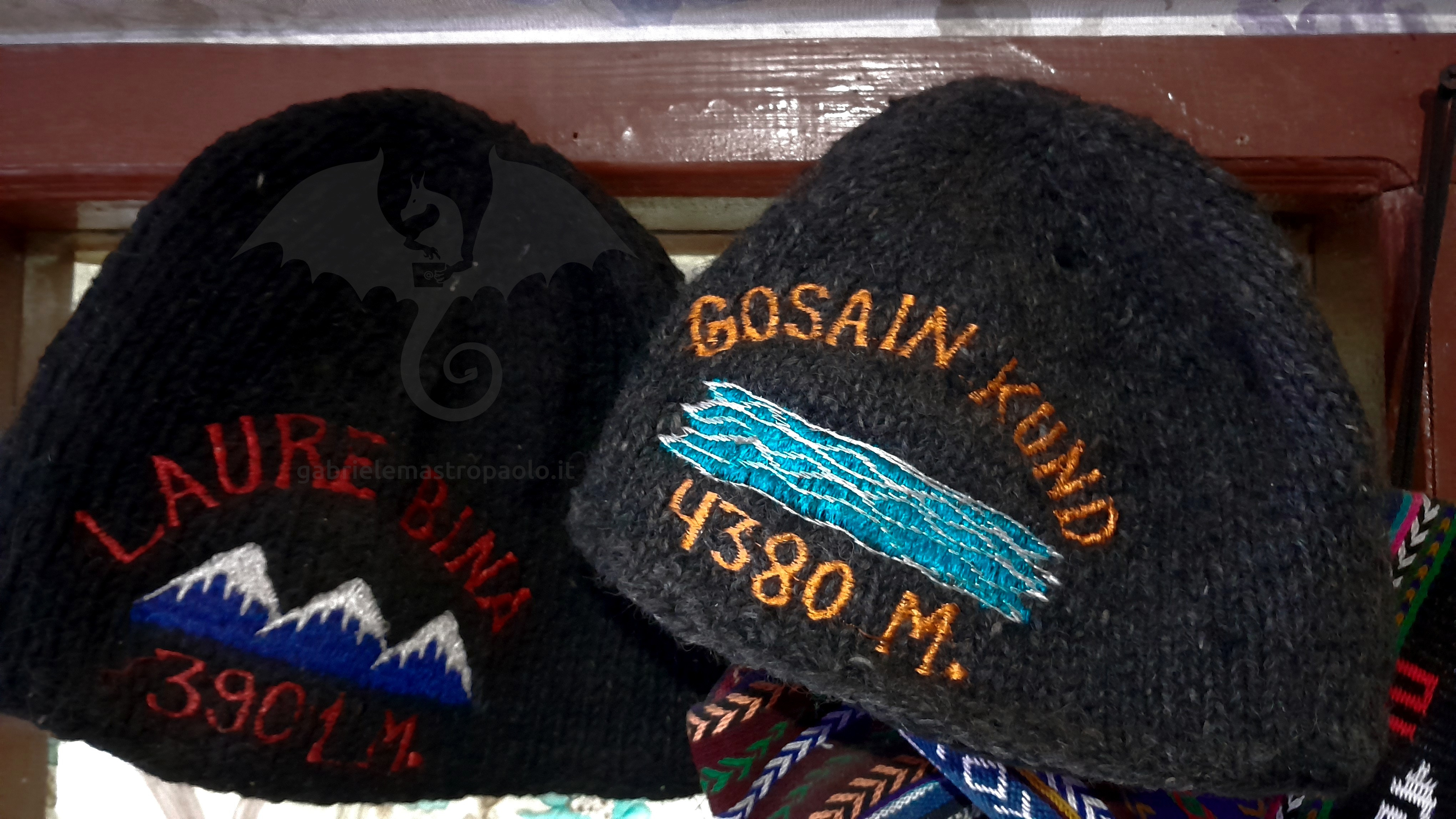 October 26, 2024, day 10
To Lake Gosaikunda awaits us an eleven-kilometer route with a one thousand one hundred and thirty meters of elevation gain. As we climb, the forest fades into rocky lands that rise above the surrounding landscape. For lunch we stop at Laurebina, at an altitude of three thousand nine hundred. Laurebina consists of only two buildings, two guesthouses. We drop our backpacks on wooden benches outside equipped with tables, then Padàm takes my lunch order. I allow myself two dishes, fried rice with vegetables and roasted potatoes. When you walk and you are uphill, eating a lot is not a wise choice but so it is, I am hungry.
To my left there is a group of Germans that I had already met in the morning along the way. One of them, a corpulent woman in her sixties, breaks away from the group and sits next to me. She rests her arms on the table and lowers her head. She closes her eyes. After a while a thread of drool begins to hang from her lips. She is tired, the road is tough. She realizes what is happening and, a little embarrassed, she pulls herself together. She staggers back to her friends.
While waiting for lunch, I look at the view. The sky is clear, there is no wind. Below us, a carpet of white clouds. For those of us up here it is a bright sunny day, for those down there it is already dark. The peaks of the Himalayas scratch the horizon. Some of them stand out with their unmistakable silhouettes, Annapurna, the mountain of the goddess of the same name, Ganesh Himal, the snowy mountain of Ganesh, the elephant god, and then a mountain with a pair of horns on top: Manaslu, the mountain of the spirit. I observe it, and perhaps it observes me. One day we will meet, we say.
Beyond those peaks, the Tibetan border.
I eat my lunch.
Three young women arrive out of breath. They drop their backpacks, then some sit on the ground. One of them remains standing and pushes her gaze towards the horizon. We exchange a few words. She points me in the direction of Annapurna.
- I did the Annapurna loop, - she tells me satisfied. - And you? Are you going up or down? -
- I go up, - I tell her.
- Which loop did you do? -
- I come from there, - and I point to the top of Langtang Lirung, behind us.
- Which villages did you touch? - I tell her, telling her the details of my route, of Kjiangin Gompa of Kijangin Ri, of Tserko Ri, of the Langtang River, of the subtropical forest.
- Initially I wanted to do the Annapurna loop, - I explain, - but then I saw that it was too crowded and I opted for Langtang Valley. -
- I'll tell you, the Annapurna ring was a great experience but maybe your route is better, it's more varied, you see more things. On the Annapurna ring you are constantly at altitude, views everywhere, snow-capped peaks everywhere. From this point of view it's a bit monotonous. Next time I'll do the Langtang valley. -
Her words give me a sense of satisfaction, dispelling those few regrets I had for having missed the Annapurna ring.
- Where are you from? - she asks me.
- From Sicily, Italy. -
- Beautiful, - she says.
- And where are you from? - I ask her
- From Israel, - she says, looking over the valley.
A block of ice falls on our conversation. Moments of thick silence. That silence evokes images of war, Gaza, Netyanahu's face, rubble, dead bodies, echoes of bombs. But I don't intend to open the conversation. I do not think and do not intend to think that all Israeli citizens are responsible for genocide.
I bring my attention back to the mountains surrounding us by talking about Tserko Ri. Then comes her lunch and the lunch of her friends. I wish them bon appetit. I take a break before grabbing my backpack and continuing on towards Gosaikunda.
No more than two kilometers of path await us, but a height difference of four hundred meters also awaits us. Rocca Busambra, the beloved rock of the province of Palermo that I now climb as if I were looking out from my balcony, has an altitude of one thousand six hundred and thirteen meters, to reach its summit it takes four kilometers of path and six hundred meters of height difference. The comparison with what awaits me for the Gosaikunda is easy to make. The double meal of lunch is making itself felt but never mind, I proceed more slowly, after all I am in no hurry.
A little further up in Laurebina there is the Laurebina Pass. We allow ourselves a break. There is a bronze statue of Buddha surrounded by hundreds of colored pennants. The panorama extends everywhere, a sense of peace extends everywhere, a sense of balance. I sit on a dry stone wall.
I do nothing else for a good half hour.
The path climbs up the rocks. The perimeter is equipped with a handrail to ensure the passage of the crowds of devotees of Shiva and Buddha. To our right, the abyss.
 We arrive at Gosaikunda when it is almost sunset. The village offers the most essential. My room has a double bed. It has only that. It is set between the rotten wooden walls. My foot is longer than the distance between the door and the edge of the bed. There is no room for the backpacks. It is not a room, it is a nest, a nest colored by the sheets and duvets provided. A sliver of sunlight illuminates that nest making it seem larger. It all delights me. I unpack the necessary things on the bed, retrieve the volume from the backpacks and collapse them on the floor, or whatever resembles it. I lie down on the bed, take off my boots and put them under the bed. I put on my walking shoes. When I go to retrieve the boots the next day I will find only one. There is a hole in the floorboards. The boot has fallen into the hole. I grab my cell phone and activate the flashlight mode. The hole overlooks the living rock. Down there is a whole history of fallen objects. At the bottom there is also my boot, not far down, balanced on a spur. I retrieve it by holding out the handle of an umbrella.
There are few guests in the guesthouse but the guesthouse is a nest, so the dining room is crowded. We are all around the fire of a wood stove.
We are at an altitude of four thousand three hundred, outside there is ice.
There are some Italians. There is a couple, she is from Genoa, he is from Cremona and they live in Sardinia. They often go to Sicily, he has friends in the Madonie.
They also talk about San Vito, Monte Cofano, Macari which they have heard about also thanks to the TV but where they have never been. I make myself available for a tour in those parts, I know that area well. In Sardinia they deal with welcoming tourists but also with hiking. I promise myself to do the 'wild blue', the Sardinian path. They reciprocate my availability. We exchange phone numbers.
There are also three Lombards, a man and two women. We chat about the Alps, the Italian four thousand, the Matterhorn or Cervino, Monte Rosa and its circuit. They have never been to Sicily. Dinner arrives.
As usual, at 8 pm I am already in my room, or rather, in my nest. During dinner one of the two women gives me a headache, asks me if I have ever slept at high altitude, I tell her that I slept up to an altitude of three thousand nine hundred, at Kjiangjin Gompa, here it is different, she says, we are higher, the difference in oxygen is felt. She says that the first time she was at the Margherita Hut during the night she had an asthma attack, she had to open the window and take long gulps of air. The Margherita Hut is the highest refuge in Europe, four thousand five hundred and fifty meters, Punta Gniffetti, Monte Rosa massif. She adds that those who snore are more sensitive to the phenomenon. I tell her that I snore, and a lot, and at Kjiangjin Gompa I slept like a log and that I hope to sleep like a log here too.
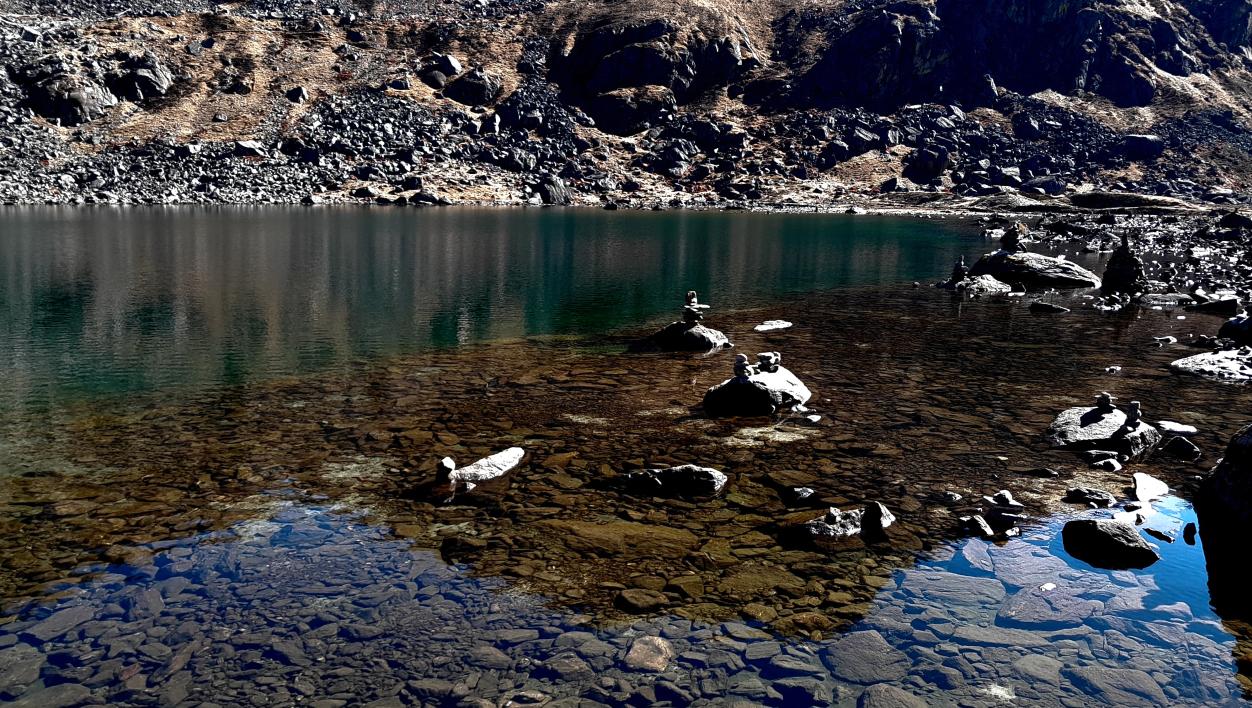 October 27, 2024, day 11
And indeed, here too I sleep like a log. My Lombard friend ignores that there may be other reasons why I can't sleep at night at any altitude, for example visits from damned sciatic exhibitionists. Yet during the night my personal sciatic exhibitionist disappeared. But thinking about it, since the climb to Thulo Syabru began, that is, since the second part of my journey began, the silent part, the part expressly dedicated to solitaries, the sciatic exhibitionist has relegated himself to a song. Did Shiva and Buddha do me a favor? Better not to sing victory. At breakfast, my Lombard friend asks.
- How did it go? -
- I feared worse, - I answer. She looks at me with her eyes wide open. During the night, someone had repeatedly let out violent coughing fits. It was her.
After breakfast, I say goodbye to the Lombards, they continue beyond the lake, towards Valle Helambu. Other guests also leave. In the guesthouse, I, Padàm and the Sardinians remain. I treat myself to a tour of the lake. I am the only one to treat myself to that tour, the Sardinians enjoy the warmth of the wood stove. The man, named Michele, gives me some off-trail suggestions, he had already done it the day before I arrived. When I walk in the mountains, off-trails are my favorite. Maybe not only when I walk in the mountains, maybe my life is off-trail too, unmarked paths, improvisation, a spirit of adaptation, no certainties, no reception facilities, few people to share who knows what with.
The shores of the lake are frozen. On the surface of the water, sheets of ice streaked with cracks sway. A few meters from the shore, the water changes color, from transparency to an intense blue, down there, under the still surface of the water that reflects the surrounding peaks like a mirror, there is a precipice, the lake is very deep and dangerous, the whirlpools have claimed some victims, confirming how the sacred goes hand in hand with danger. The lower shores are dotted with small monoliths formed by many stones one on top of the other, they are the most discreet signs of the typical enthusiasm of those who go to the mountains, signs that hide philanthropy. an unwritten code shared by all walkers, futuristic messages delivered to the wayfarers to come; in a fit of absence, the walker stops, looks around, picks up some stones, places them one on top of the other, some lose their balance, he puts them back in a more stable equilibrium until he places the smallest pebble on top and the monolith is made and whoever comes after will find that monolith and will understand that someone has passed by there, that after all he is not so alone, that in his solitude he can continue his journey certain that the path is the right one, a path furrowed by a crowd of many solitudes.
Voices. Noises. Joyful screams. Flirty high notes.
There is a small concrete area with a small stupa. There are some people, boys and girls. One of them has wet hair and is wearing a swimsuit, another one is apprehensively placing a beach towel on her shoulders; two other boys are in the water, one of them is screaming and laughing, laughing and screaming and then diving in.
I go back to my guesthouse. There is a Hindu holy man sitting on the floor in the lotus position, he is wearing an orange tunic and a corolla of flowers, he has a long black beard. We look at each other.
- Namaste! -
- Namaste! -
Someone has rung a bell. The frozen screams of the boys in the water. Then silence.
The plan includes another night here at Gosaikunda but with Padàm we agree to go down to Laurebina after lunch and spend the night there. I liked that place a lot, which then allows us to break the descent, the journey is now coming to an end, for the last day, that is the next day, a long descent towards Dhunche awaits us.
The return is even more desolate than the outward journey. These are the last hours, the last kilometers of the Nepalese trail furrowed by my footsteps. There is a thin veil of melancholy, the melancholy of certain things that end and begin to become memories, the melancholy of those things that made you feel good. My absence still finds fulfillment in those panoramas scratched by snow-capped peaks, accompanied by silence.
We reach Laurebina Pass, we stop, we have an appointment. Padàm signals to me that they are climbing, they are a few minutes away from us. They are two Sherpas who will deliver me the red jacket that I forgot two days before in Thulo Syabru. After I realized what had happened, Padàm called Mr Rakesh, the owner of the hotel, and Mr Rakesh reassured us by telling us that in two days two Sherpas would go up to Gosaikunda to deliver goods, we would meet halfway, they would bring me the jacket. And so it is.
One of the two Sherpas rests his load on a rock, reaches in, takes out his jacket, and hands it to me smiling.
- It's for you, sir. -
I thank him with a thousand Nepalese rupee note. He is embarrassed, says no no, Padàm encourages him to accept them, so even more embarrassed, among a thousand bows, the Sherpa takes the note from my fingers. One thousand rupees, a little more than six euros. For someone who earns two hundred and fifty rupees per load, walking in slippers for tens of kilometers with differences in altitude of hundreds of meters, that note is a relief.
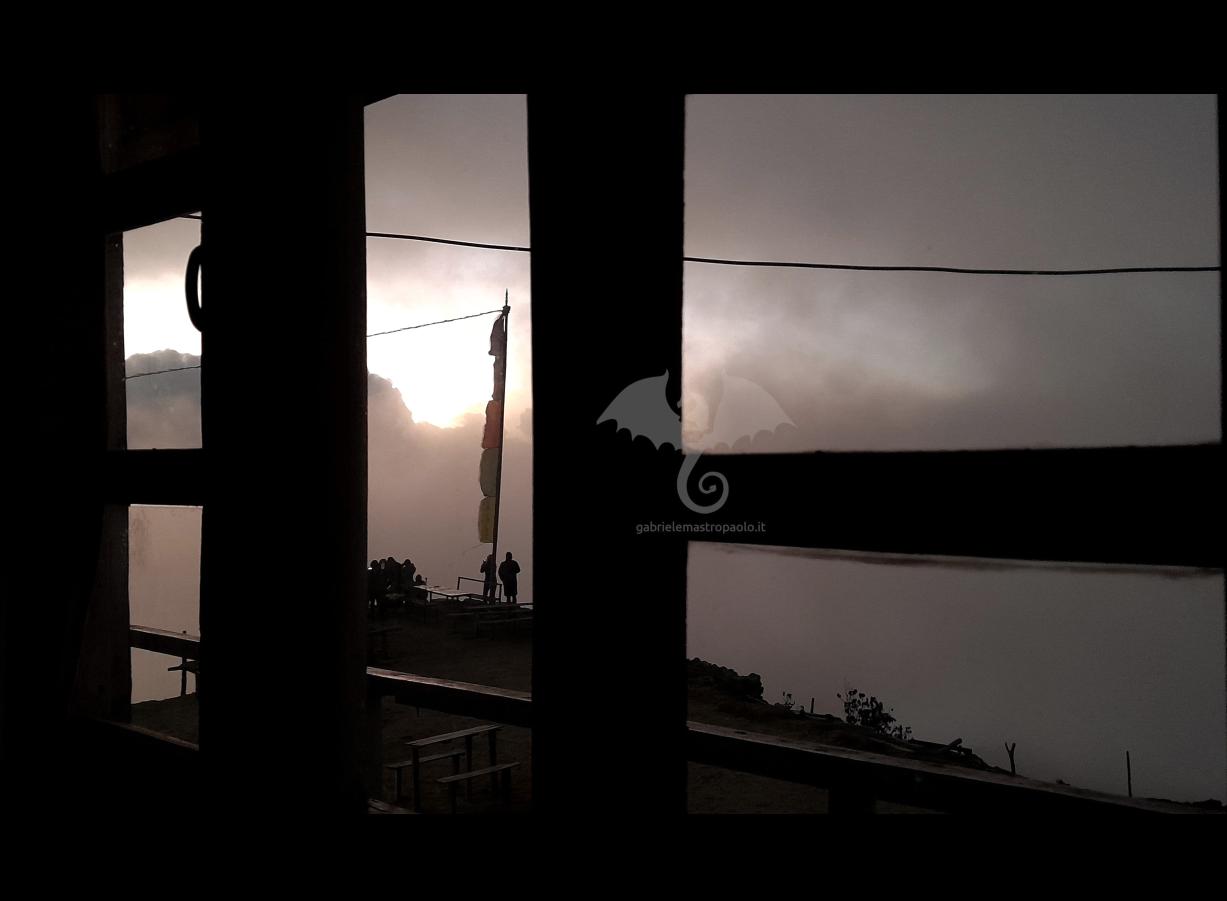 Laurebina.
I take possession of the room. The other day the carpet of clouds was at a lower altitude, this time it covers the sky above us. On the horizon, the peaks of Ganesh Himal and Manaslu fade into gray blankets. After an hour, the village is wrapped in a thick fog. I have dinner. I go up to the room. The structure - the stairs, the corridor, the terraced balcony, except for the bathrooms - is entirely made of wood, almost dated wood. My footsteps echo like those in Vincent Price's films. I try to make the comparison plausible: I become the silhouette at the end of the corridor, a long corridor, with the perspective lines accentuated in a wide-angle distortion, like in the corridor of Jennifer Connely - oh, Jennifer! - sleepwalking in Dario Argento's PHENOMENA, with that wonderful track by Claudio Simonetti in the background, I become the dark presence of this desolate and deserted place. But not for long. In five minutes that structure will be populated by noisy killer cockroaches and unfortunately it is not a Kafka delirium: they will come up in droves from the hall/dining room, they will be drunken Sherpas and local tourists, they will fiddle with the bolts on the doors, they will have difficulty finding the right key and will have difficulty inserting it into the lock, this will trigger jokes, gags, pats on the back, hysterical hilarity, and when they finally manage to possess the rooms they will joke, in a great saloon-like racket they will throw their backpacks on the fragile wooden floor that is almost dated, and the dark figure that is in me will reveal itself for what it is, a killer, the Jason from FRIDAY THE 13TH, but what for me is a horror movie set, for those little monsters is that of a western movie. I have already been to Monument Valley, there were the typical rocks, there was the dust raised by the wheels of the stagecoaches fleeing from the Paiute Indians, there was the point where John Ford stood and gave orders to the crew, there were coyote tracks, there was the sinuous trail of fleeing rattlesnakes, there were no rednecks of that kind.
Once the euphoria has worn off, the insects calm down, until they descend into the dining room like the delirium of schoolchildren at recess.
I sit on the bed and look out the window. I watch the coils of fog stretch out like dragon necks on the peaks, envelop the high-voltage poles in a sadomasochistic performance, slowly rise, slowly fall, chase each other, wrap themselves up, pile up in an orgy, mount what little sun remains at dusk, make it redder, no one knows whether from shame or lust, make it grayer, no one knows whether drained or summoned by a werewolf zombie, make it black, no one knows whether from a curse or in symbiosis with my murderous instinct, until authentic darkness prevails over everything.
I spend a quiet night. The exhibitionist is silent.
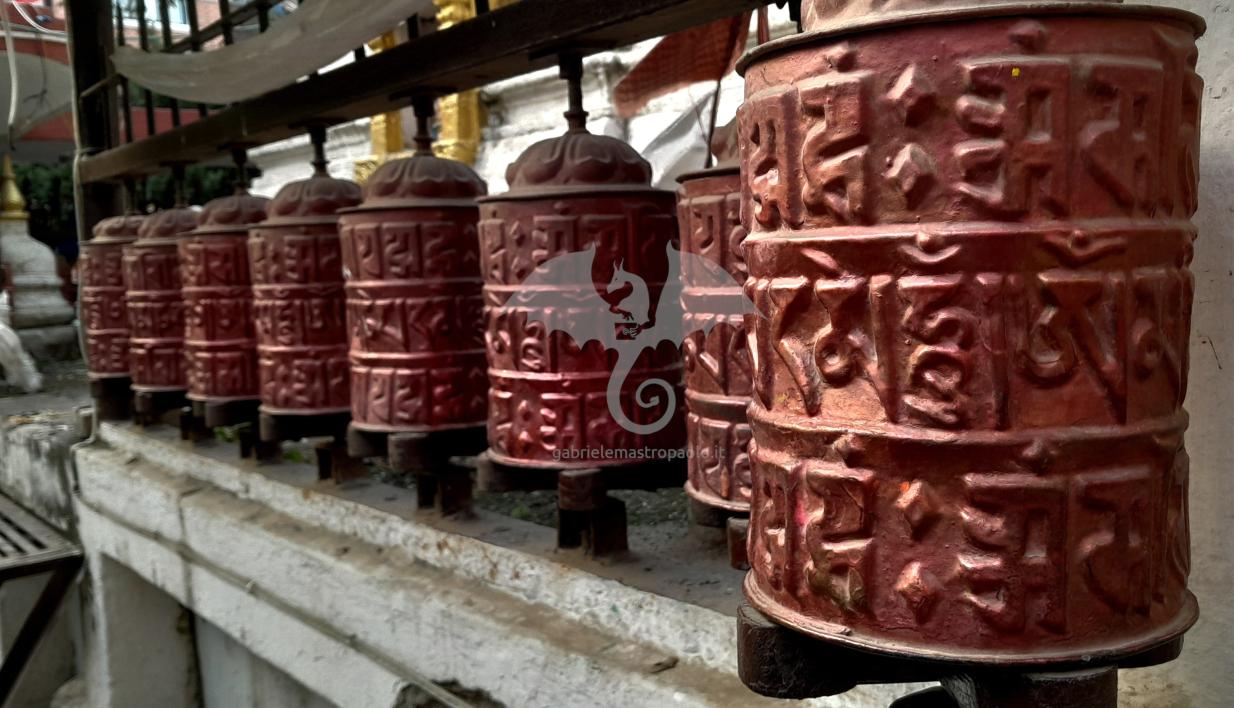 October 28, 2024, day 12
Fifteen kilometers and just under two thousand meters of altitude difference, all in a single ride over rocks, on steps of unsteady stones, on stones that compromise balance, with the poles propped up on the ground, with the roar of the river - this time the Gosaikunda Khola, or river - escorting us over ravines, on paths as wide as paper napkins. That is what we travel. Other villages on the mountain slopes, other Sherpas balanced with their loads, other hikers - a handful in all - stopping in the guesthouses, other inebriating essences from the vegetation of the subtropical forest. Other occasions of absence.
We descend to the riverbed, at a point where it becomes flatter, within reach of the pilgrims who pray on its sacred and dangerous banks. The path rises again, takes on the appearance of a concrete slab, a slab that just before becoming rough ground again intercepts an off-road vehicle parked at its edge. Leaning on the hood of the off-road vehicle, two men chatting like two good guys. One of them shouts something to Padàm in Nepali, I think I can guess what he's shouting at him.
- Tell him I'm not interested, I'll continue on foot, - I say to Padàm. Padàm nods.
The path becomes a dirt road, shortly after it opens up into a town: heavy vehicles, children playing on the side of the road, dust, the stench of burnt diesel, chickens scratching around in the springs that flow from the edges, grocery stores. It's Dhunche, our destination, our last stop, the last of the entire journey.
- Look who's here, - Padàm tells me, pointing to an elderly and tired hiker. It's Rey.
- See you again, Rey! -
- Have you been to Gosaikunda? - he asks me.
- Yes, yesterday. Now it's time to go back. I'll come back better. -
- We've had a nice 'pastime', - Rey comments, he does it with a mischievous smile that suggests the quotation marks of 'pastime'. - This is the meaning of life, and not sitting in front of a TV. -
- There are better things, - I tell him, - for example going to the mall on Saturdays and washing the car on Sundays. - We laugh.
- Bye Rey, it was a pleasure meeting you. -
- I'm leaving tomorrow too, I'll see you on the bus. -
- No, - I tell him, - I rented an off-road vehicle. -
- So bye Gabriele, - he tells me in good Italian.
- Hello Rey, - I tell him in broken Spanish.
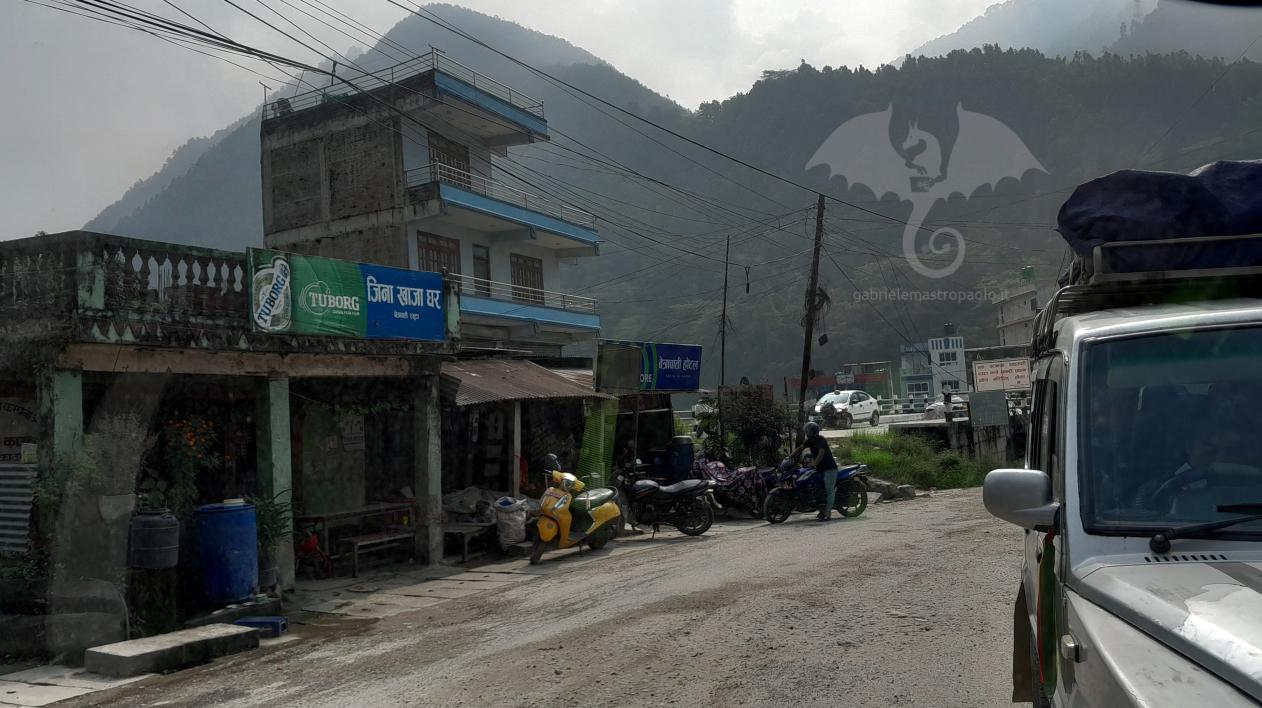 I reach Padàm, who in the meantime has been waiting for me at the entrance to our hotel. I go up to the room, take a shower. After dinner I take a walk around the city. I go back to the room. I make my way to bed. I won't be able to sleep a wink. This time the sciatic exhibitionist has nothing to do with it. Dogs. There's a pack of dogs who have decided to double-cross their drunken fellow villagers from Laurebina. They bark all night, one in particular barks relentlessly with a rhythm that recalls the assembly line in Chaplin's MODERN TIMES. Damned dogs. The next morning, already at 06:30 the off-road vehicle is stopped waiting for us in front of the hotel. We load up our stuff. A little further on, a pack of dogs, one of them breaks away from the pack and starts to come towards me, wagging his tail. I recognize him, it's him, the ignoramus, the asshole from MODERN TIMES. He wants to cuddle, but I'm already on board the off-road vehicle, he looks at me with two languid, imploring eyes, the off-road vehicle starts up, he avoids the dog's face but he stubbornly follows us wrapped in a cloud of dust. And while Dhunche and the peaks of the Himalayas slip away from my eyes to the memories on the reflections of the glass, I brandish my middle finger at him.
 This is not a Manzonian farewell to the mountains, mine is not an escape, there is not a shadow of regret in my return to my homeland, and mine is not a farewell, but rather a see you later; on the Laurebina Pass Manaslu, the mountain of the spirit, reached me with its warning. I watched it from afar, in the ecstatic contemplation of an unexpressed desire. In those places, among those valleys, those villages, those peaks I gained the best part of myself, my absence, and wherever one gains one's absence it is normal to assume one will return there.
In the West, the quintessence of the journey is that towards Ithaca, and Ulysses the quintessence of the traveler but it is a false concept: in the Odyssey there is no trace of a desire for absence on Ulysses' part, he finds himself suffering his own presence with the poignant nostalgia of home, of Penelope, of Ithaca; Ulysses sits on a rock and cries. He suffers his own journey, and while we read and admire his exploits, he is preparing to return at all costs to his Ithaca, which despite himself escapes him. Ultimately, the Western reader wants Ulysses as a fugitive, it is the reader, not Poseidon, Ulysses' bitter enemy, the true theòs who forces him into exile. Ulysses' is ultimately the story of a tragic presence. Ulysses is condemned to himself. The judge who issues the verdict is the Western reader.
There is something sadistic in the Western reader, and it is a sadism that satisfies him, and satisfies the condemnation of man to himself. Until the sixteenth century, man is an organ in the hands of God, then man discovers that he is man. In the eighteenth century, with the Enlightenment, man discovers that he can create his own world, discovers that he can be God. In the nineteenth century, man experiences the shadows of this God, of any God, in this case of this God called man and, in the twentieth century, he will end up, with Freud and psychoanalysis, by self-destructing. Man will discover that he is not up to the level of his own presence. God will die, man will remain, with his torments, his presence. The decline of the West evoked by Spengler is nothing other than the condemnation of man to himself, to the obsessive presence of himself.
It will be physics, not philosophy, that will restore a semblance of absence to man, with quantum mechanics. Quantum mechanics will restore to man the void, the indeterminacy, the immateriality of matter. Man will doubt that the more immaterial the matter, the more material the spirit. After millennia of forced separation, first by Plato and then by Christian patristics, man will finally be able to think of himself as spirit and matter in one.
But in the East they have known this for a long time. Lao Tzu's Tao Te Ching - a poem, a philosophical work, a story or whatever it is - tells all this well before Niels Bohr, Werner Heisemberg and Albert Einstein, just a few thousand years.
When I actually realized the idea of leaving for Nepal, some of my friends snubbed my initiative saying:
- What are you going to do in Nepal? In Italy we have those mountains! -
The whole world envies us the Dolomites. The Dolomites are full of trails that wind everywhere through their panoramas. One of the most challenging and complete trails is the Alta Via 2. The Alta Via 2 flies over the rugged peaks of the Dolomites between Bressanone and Feltre. Bressanone and Feltre are two very beautiful and very un-Mediterranean cities, on a human scale, where the houses have sloping roofs, the grass is green, the lawns are well-kept, the infrastructure is Austrian-made, that is, decent, without a hole, asphalt as a mirror surface, where light and, let's imagine, water are never lacking, where there are no small cars, where nothing is left to chance and neglect, in short, they are cities where everything is glossy, even life. But it's not just about Bressanone and Feltre. Is it clearer now why I chose to go to Nepal?
My next trip will be to the Dolomites. I will do the Alta Via 2. I will do it to take possession of the Dolomites, to find the absence of Bressanone and Feltre. I will do it to take possession of my absence there too.
Gabriele Mastropaolo.